An honest look at the cleaning contract model, who it actually serves, and how to evaluate vendors across Massachusetts, Connecticut, and Rhode Island.
Walk into almost any commercial cleaning sales conversation and a 12 to 24 month contract is on the table within the first ten minutes. That has been the industry default for decades, and for most facility managers it feels like a normal cost of doing business. Lock in the rate, lock in the vendor, move on to the next problem.
It is worth slowing down on that one. The contract structure your cleaning vendor proposes tells you a lot about how they actually run their business, where their incentives sit, and whether quality is going to hold up six months from now when nobody is watching as closely.
This post walks through why long-term cleaning contracts became the norm, what is actually wrong with them for most buyers, what “no contract” really means in this industry, where contracts still make sense, and what to ask before you sign anything. It is written for facility managers and business owners across Massachusetts, Connecticut, and Rhode Island who want to make a clear-eyed decision rather than a default one.
Table of Contents
- Why Long-Term Contracts Became the Industry Standard
- The Real Problems With Locked-In Cleaning Contracts
- What “No Contract” Actually Means
- The Honest Trade-Offs
- Red Flags to Watch For in Cleaning Contracts
- How to Vet a No-Contract Vendor
- When a Long-Term Contract Actually Makes Sense
- Questions to Ask Before You Sign Anything
- How Modular Concepts Structures the Relationship
- The Bottom Line
1. Why Long-Term Contracts Became the Industry Standard
Commercial cleaning is a low-margin business. Vendors absorb real onboarding costs when they take on a new account, including site assessments, crew training on facility specifics, supply staging, and the inevitable calibration period where the work is not yet running smoothly. From the vendor’s perspective, a 12 or 24 month contract amortizes those startup costs across enough months to make the relationship profitable.
That logic created a self-reinforcing industry standard. Vendors quote with contracts because their margin model assumes a contract. Procurement departments at larger companies got used to negotiating multi-year terms. Auto-renewal clauses became boilerplate. Buyers who had never seen a different model assumed contracts were how cleaning gets bought.
None of that is wrong, exactly. It is just one way to structure the relationship, and it is a way that benefits the vendor more than the buyer in most situations. Once a contract is signed, the vendor’s revenue is secure regardless of how the work performs day to day. The buyer is the only party with continued accountability pressure, and that asymmetry is where most of the problems start.
2. The Real Problems With Locked-In Cleaning Contracts
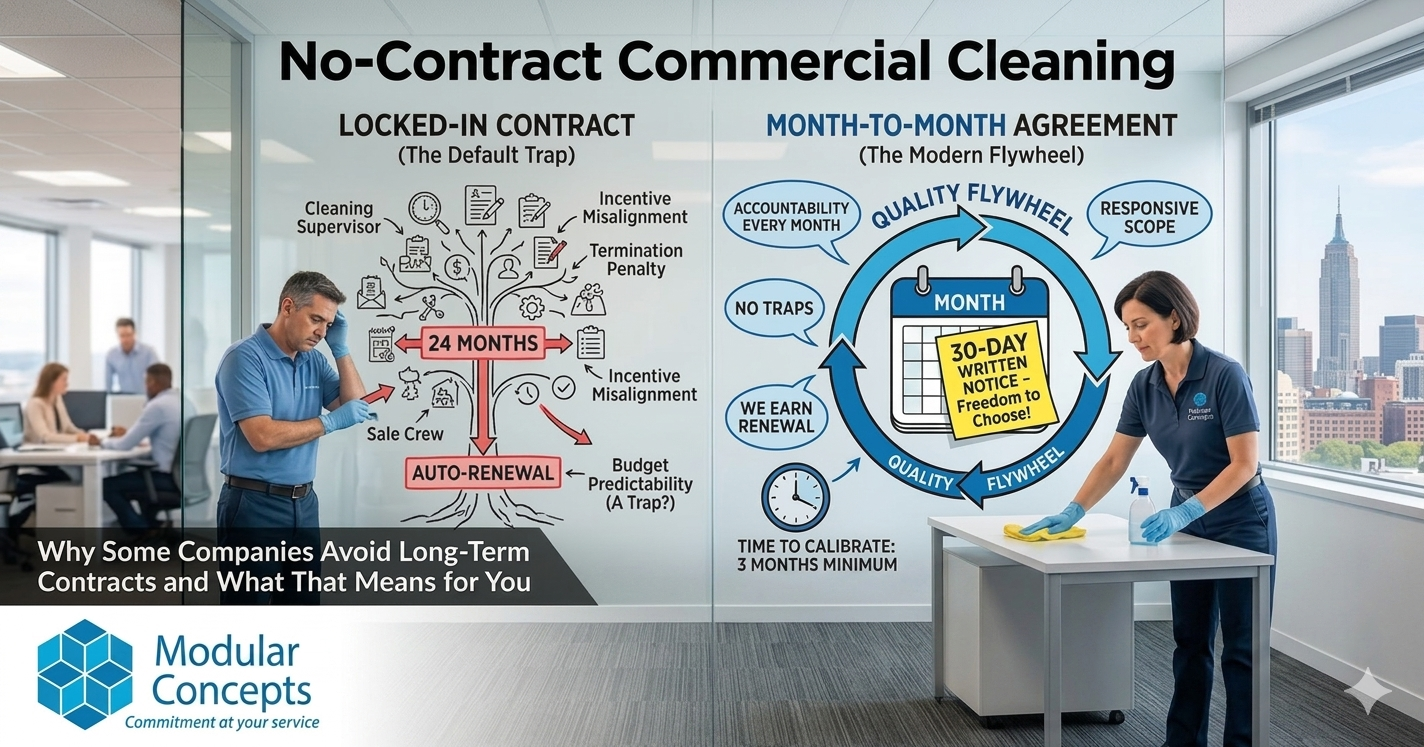
The single biggest issue with long-term cleaning contracts is incentive misalignment. When a vendor has 18 months of guaranteed revenue, the pressure to maintain quality month over month softens. The crew that performed beautifully during the sales process and the first ninety days slowly gets reassigned. The supervisor who walked the building weekly starts coming monthly, then quarterly. Quality drifts. Most buyers do not notice until they are deep into year two and the building does not look the way it used to.
Auto-renewal clauses make this worse. Many cleaning contracts renew automatically unless the buyer cancels in a specific window, often 60 or 90 days before the term ends. Miss that window and the contract rolls for another full term, frequently with a built-in price escalator. Buyers who get frustrated with quality often discover they are six months from being able to leave.
Termination penalties layer on top. Even when a contract has an exit clause, the penalties for early cancellation can be substantial enough to keep a buyer locked in to a bad relationship. The vendor knows this, the contract reflects it, and the leverage runs one direction.
Scope changes are another quiet problem. The cleaning needs of any active business shift over time. New tenants move in, departments expand, hours change, a renovation gets scheduled. With a locked contract, every meaningful scope change becomes a renegotiation, and the vendor holds the better hand because the buyer cannot easily walk away.
3. What “No Contract” Actually Means
The phrase “no contract” is sometimes interpreted as a handshake deal with no paperwork. That is not what a legitimate no-contract cleaning relationship looks like, and any vendor offering that should be avoided.
A real no-contract structure is a month-to-month service agreement. There is still a written scope of work that defines exactly what gets cleaned, how often, and to what standard. There is still a documented price. There is still an insurance certificate, a bonding confirmation, and the same compliance documentation you would expect under any contract. The agreement spells out cancellation terms, typically a 30-day written notice from either party.
What is missing is the multi-year lock and the auto-renewal trap. The relationship continues because both parties want it to continue, not because one of them is legally compelled to stay.
Some vendors offer hybrid structures, including a short minimum term followed by month-to-month. A 3-month minimum is common and reasonable. It gives the vendor enough runway to absorb onboarding costs and calibrate the work, and it gives the buyer a full quarter to evaluate quality before going fully flexible. After that initial period, either party can end the relationship with standard notice.
4. The Honest Trade-Offs
This is the part most blog posts skip. There are real reasons some buyers choose long-term contracts, and pretending otherwise is sales fiction.
Long-term contracts can produce slightly lower per-month rates in exchange for the term commitment. The vendor is willing to discount because they have revenue certainty. For multi-site facility operators where every dollar of cost reduction multiplies across many buildings, that math sometimes works.
Long-term contracts can also produce more customization. Vendors are more willing to invest in facility-specific training, dedicated equipment, or specialized staffing when they know the account will be there long enough to justify the investment. For complex facilities like research labs, large hospitals, or specialized manufacturing, that depth matters.
And long-term contracts produce budget predictability. For organizations where annual budgets are locked at the board level, having a fixed cleaning line item simplifies planning.
On the other side, no-contract vendors hold themselves accountable every month because they have to. They tend to be more responsive on scope changes because flexibility is part of how they win. They eliminate auto-renewal traps and exit penalties. And they put the buyer back in the position of choosing to continue based on actual performance rather than legal obligation.
For most small to mid-size commercial facilities, the no-contract model is structurally better. The discount on a long-term contract is rarely worth the loss of leverage, and the customization argument does not apply at this scale.
5. Red Flags to Watch For in Cleaning Contracts
If you are reviewing a long-term cleaning contract, these are the clauses that deserve scrutiny before you sign.
Auto-renewal language without a clear, reasonable cancellation window. Anything requiring more than 60 days written notice is aggressive. Anything requiring more than 90 days is a problem.
Annual price escalators without a cap. A 3 to 4 percent annual increase tracking inflation is reasonable. Open-ended escalators or increases tied to vague “market conditions” are not.
Termination penalties that exceed reasonable cost recovery. A vendor recovering 30 to 60 days of remaining contract value for early termination is defensible. Penalties equal to the entire remaining term are punitive and predatory.
Vague scope of work documentation. The agreement should specify exactly what is cleaned, how often, and to what standard. “General office cleaning as needed” is not a scope. It is a future dispute.
Missing performance standards or service level expectations. Without defined SLAs and a measurable quality standard, the vendor has no obligation to meet any particular bar.
Non-disparagement clauses. These prevent you from leaving honest reviews if quality declines. Their presence in a cleaning contract is a tell.
Right-of-first-refusal language on related services. This locks you into using the same vendor for additional services you have not yet scoped, often at unfavorable rates.
6. How to Vet a No-Contract Vendor
The flip side of avoiding bad contracts is making sure the no-contract vendor you pick is stable, professional, and not just disorganized.
Look at how long they have been in business. A no-contract model only works if the vendor delivers consistent quality, and that consistency takes time to build. Five plus years in operation is a reasonable floor.
Ask for current references with at least 18 to 24 months of relationship history. A vendor whose retention is short suggests their no-contract model is functioning as a revolving door rather than a quality flywheel.
Verify insurance, bonding, and worker’s compensation coverage. None of this is contract-dependent. It should be in place regardless of how the relationship is structured.
Ask about crew retention. High crew turnover hurts cleaning quality more than almost any other operational variable. Vendors that pay fairly, train well, and treat their crews like professionals tend to have better retention, and that shows up in the work.
Look for industry credentials. BSCAI verification through the Building Service Contractors Association International is a strong baseline signal that a contractor operates to professional standards independent of their contract structure.
Ask who from the vendor’s leadership visits client sites and how often. If the answer is “nobody” or “only when there is a complaint,” the quality control system is the crew alone. That works for some accounts, but not the ones where standards matter.
7. When a Long-Term Contract Actually Makes Sense
Some buyers genuinely need a long-term contract structure. Being honest about when that applies is part of giving useful advice.
Multi-site enterprises with centralized procurement often need contracts because their internal procurement processes require them. The same is true for many publicly funded entities, school districts, and government facilities, where the bidding and contracting structure is non-negotiable.
Highly specialized facilities sometimes need them too. A research lab requiring dedicated trained crews and specialized equipment, a high-acuity healthcare facility with strict continuity requirements, or a manufacturing operation with security clearance requirements all benefit from the depth a long-term commitment enables.
Organizations with strict annual budgeting requirements, particularly those reporting to a board with rigid line-item planning, may need the predictability of a fixed annual cost. Some lease-based commercial buildings build cleaning into the tenant agreement under multi-year structures.
Outside of those situations, most commercial facilities are over-buying when they accept a multi-year cleaning contract. The default does not fit the actual need.
8. Questions to Ask Before You Sign Anything
Whether you are evaluating a contract or a no-contract proposal, these are the questions that surface what you are actually agreeing to.
What is the exact cancellation notice period and process? If the answer is anything more than 30 days written notice for a no-contract structure, or anything more than 60 days for a contract, push back.
Is there an auto-renewal clause? If yes, what is the cancellation window and how do I prevent renewal? Get the cancellation date in writing on day one and put it on your calendar.
What are the price escalators over the term? Cap them. “Tied to CPI with a 3 percent ceiling” is reasonable. Anything open-ended is not.
How are scope changes handled? What is the process and the pricing structure for adding or removing services?
What are the performance standards and how is quality measured? Who is accountable if standards are not met?
Who is the dedicated point of contact, how often will they visit my site, and what is the escalation path if I am not satisfied?
What insurance, bonding, and worker’s compensation coverage is in place? Request current certificates.
If the answers come back vague, evasive, or visibly irritated, you have learned something useful about the vendor before signing anything.
9. How Modular Concepts Structures the Relationship
Modular Concepts works on a 3-month minimum followed by month-to-month service. The 3 months gives us enough runway to onboard properly, calibrate the work to your facility, and prove the quality. After that, either party can end the relationship with 30 days written notice.
There is no auto-renewal trap, no termination penalty, and no annual price escalator baked in without conversation. The scope of work, the pricing, and the cancellation terms are documented in plain language up front.
This structure only works because we earn the renewal every month. If the work slips, we lose the account. That accountability sits at the heart of how we operate, and it is why our owner Luiz Thomas personally visits client sites on a regular cadence rather than disappearing once the ink dries.
We are BSCAI verified, fully insured and bonded, and we serve commercial facilities across Massachusetts, Connecticut, and Rhode Island. The model is structured this way because we believe it is the right way to run a cleaning business, and because the buyers we want to work with are the ones who appreciate that structure.
10. The Bottom Line
The contract structure your cleaning vendor proposes is a values signal as much as a legal document. A vendor confident in their work over the long run does not need a 24-month lock to keep your business. A vendor who needs the lock is telling you something about how they think the relationship will go once the sales process ends.
Match the structure to your actual needs. If you run a multi-site enterprise with procurement requirements, a contract may be unavoidable, and the questions in this post will help you negotiate a fair one. If you run a single facility or a small portfolio of buildings, the no-contract structure is almost certainly the better fit, and the vetting checklist will help you find a stable vendor that delivers.
If you operate a commercial facility in Massachusetts, Connecticut, or Rhode Island and you want a cleaning partner who has to earn the renewal every month, Modular Concepts can help. Reach us at (508) 658-0303 for a no-obligation walkthrough and quote. We will tell you honestly what your facility needs, what it should cost, and exactly what the relationship structure looks like before any paperwork is exchanged.