A practical comparison for facility managers across Massachusetts, Connecticut, and Rhode Island.
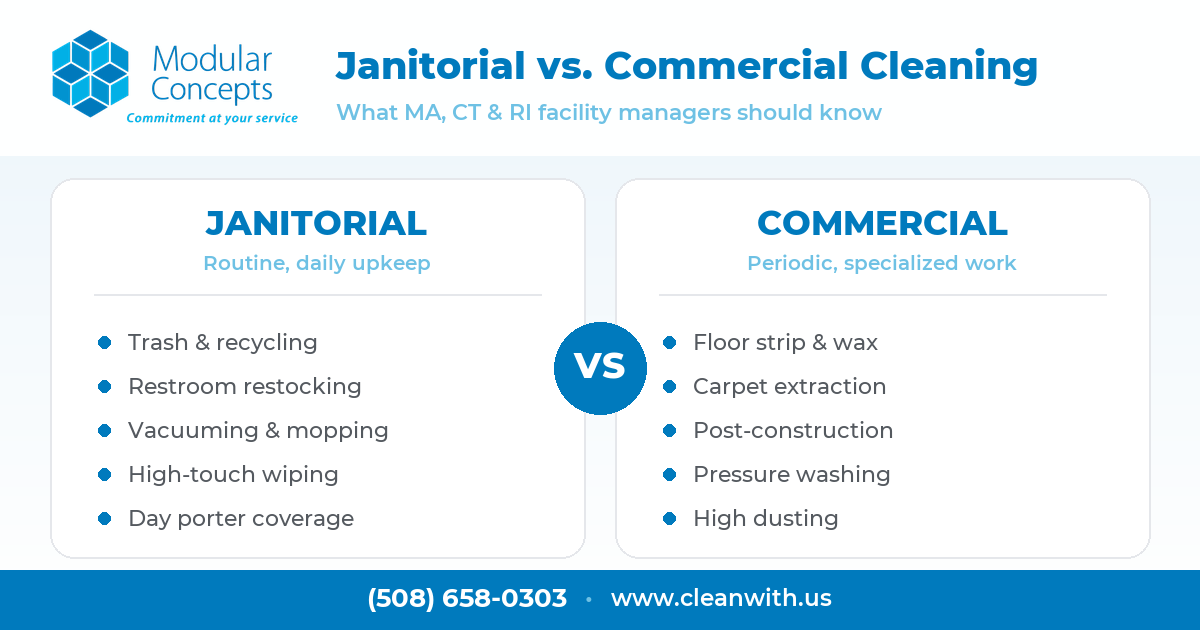
Janitorial services and commercial cleaning describe two different scopes of work. Janitorial services are the routine, recurring tasks that keep a facility running day to day: trash removal, restroom restocking, vacuuming, and surface wiping. Commercial cleaning is the broader category that also includes periodic, specialized work like floor stripping, carpet extraction, and post-construction cleanup. Most facilities need a blend of both, and the right mix depends on building type and traffic.
Janitorial services and commercial cleaning get used as if they mean the same thing. They do not. The distinction determines what shows up in your building, how often, and what you are actually paying for. Get it wrong and you either overpay for specialized work you rarely need, or you underbuy and watch the facility degrade between visits.
We field this question constantly from facility managers across Massachusetts, Connecticut, and Rhode Island. A property manager wants nightly upkeep but writes a scope that reads like a quarterly deep clean. A practice administrator asks for janitorial pricing but actually needs periodic floor care. The labels are fuzzy. The work is not.
Here is the practical breakdown: what each term covers, where they overlap, when you need one or the other, and the questions that reveal which vendor actually understands the difference.
Table of Contents
- 1. What Janitorial Services Actually Cover
- 2. What Commercial Cleaning Actually Covers
- 3. Side by Side: Where They Overlap and Where They Diverge
- 4. When Janitorial Services Are the Right Choice
- 5. When Commercial Cleaning Is the Right Choice
- 6. The Hybrid Case: When You Need Both
- 7. Common Misconceptions About the Difference
- 8. How to Figure Out What Your Facility Actually Needs
- 9. What to Ask a Vendor About Either Option
- 10. The Bottom Line
- Frequently Asked Questions
1. What Janitorial Services Actually Cover
Janitorial services are the recurring, routine tasks that keep a facility functional and presentable on a daily or near-daily basis. This is the work most people picture when they think of cleaning: emptying trash and recycling, cleaning and restocking restrooms, vacuuming carpet, mopping hard floors, wiping high-touch surfaces like door handles and shared desks, and tidying breakrooms.
The defining trait is frequency and consistency, not complexity. A janitorial scope is measured in visits per week, usually performed after hours by a crew that knows the building and follows a fixed route. The value is not that any single task is difficult. It is that the work never lapses, so the building looks the same on Monday morning as it did the Monday before.
In higher-traffic buildings, janitorial coverage extends into the workday through a day porter who handles restrooms, spills, and common areas while the facility is occupied. That is still janitorial work. It is simply scheduled during business hours instead of after them.
2. What Commercial Cleaning Actually Covers
Commercial cleaning is the broader umbrella. It includes janitorial work, but it also covers the periodic, specialized, and equipment-driven jobs a nightly crew is not scoped or equipped to perform.
Commercial cleaning is the full category of professional cleaning performed in business and institutional facilities, spanning both routine janitorial upkeep and periodic specialized services. Those specialized services include stripping and waxing hard floors such as VCT, vinyl, and tile, machine extraction of carpet, post-construction cleanup, pressure washing of exterior hard surfaces, high dusting, window cleaning, and structured disinfection of high-touch areas.
These jobs run on a quarterly, semi-annual, or project basis, or in response to an event like a renovation or a tenant turnover. They also require different tools and training: auto-scrubbers and carpet extractors instead of a vacuum and a mop bucket. A crew set up for nightly upkeep cannot strip a floor properly, and a floor-care technician is overqualified to empty your bins every night. That is why the two are scoped differently.
3. Side by Side: Where They Overlap and Where They Diverge
The two categories overlap at the routine end and diverge sharply at the specialized end. Every commercial cleaning relationship includes janitorial work, but not every janitorial contract includes commercial cleaning. The clearest way to see the difference is to compare them across the factors that actually drive your decision.
| Factor | Janitorial Services | Commercial Cleaning |
|---|---|---|
| Frequency | Daily to weekly, recurring | Periodic, quarterly, or project-based |
| Scope | Routine upkeep | Routine plus specialized deep work |
| Equipment | Carts, vacuums, mops | Auto-scrubbers, extractors, pressure washers |
| Pricing | Monthly recurring rate | Per-project or scheduled add-on |
| Goal | Maintain a baseline | Reset or restore a surface |
Read the table as a spectrum, not a wall. Janitorial work maintains a baseline so the building never falls behind. Commercial cleaning resets or restores a surface that routine upkeep cannot recover on its own. A vacuum keeps a carpet presentable for months, but only hot-water extraction pulls out the embedded soil that dulls it. Both matter. They simply solve different problems.
4. When Janitorial Services Are the Right Choice
If your facility has steady daily traffic and you need it to look and function consistently every morning, recurring janitorial service is your anchor. This covers most commercial offices, co-working spaces, education facilities, non-profits, and medical offices, where daily use generates daily soil.
The math is straightforward. A 10,000 square foot office with 40 staff produces trash, restroom use, and floor traffic every single day. A monthly deep clean, however thorough, cannot keep up with that volume. The mess compounds between visits and your team feels it within the first week.
Janitorial service is where consistency compounds in your favor. A clean baseline maintained five nights a week prevents the buildup that later forces expensive restoration. Skip it and you do not just get a dirty office. You shorten the life of your floors and carpet and create the conditions that eventually require the heavier commercial work to fix.
5. When Commercial Cleaning Is the Right Choice
Commercial cleaning earns its keep when a surface or space needs a reset that routine upkeep cannot deliver. These are the jobs you schedule on a cycle or trigger with an event, not tasks you repeat nightly.
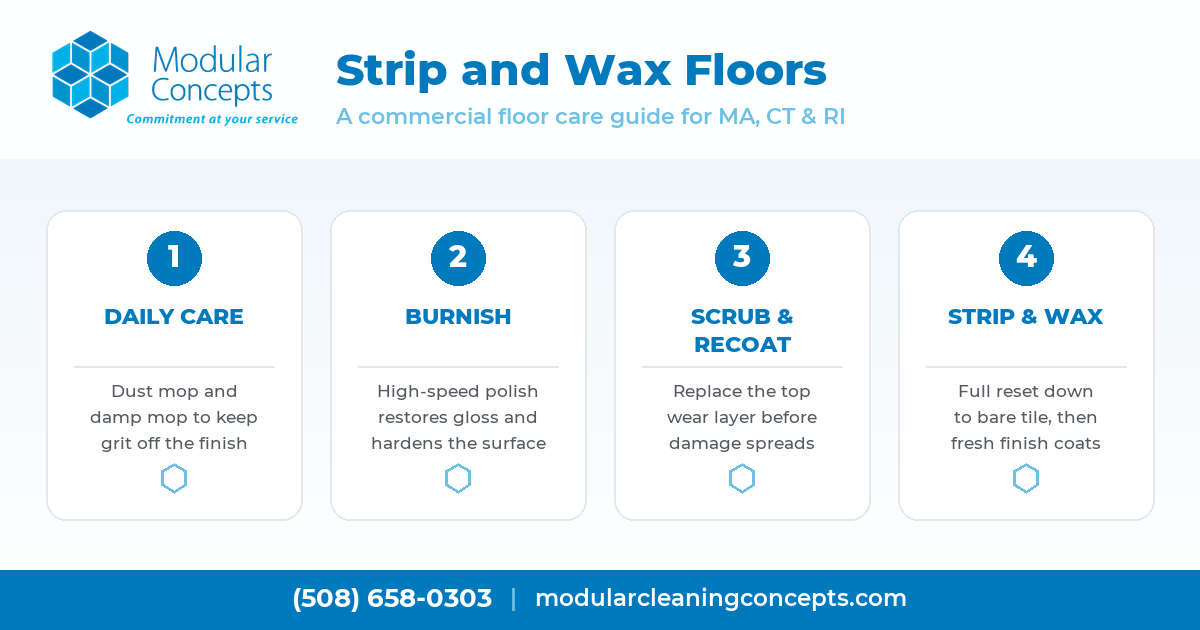
VCT floors that have lost their finish need stripping and re-waxing once or twice a year to stay protected and bright. Carpet in a high-traffic lobby needs hot-water extraction quarterly, well before the soil becomes visible. A renovation leaves fine drywall dust on every ledge and inside every vent, and a standard vacuum spreads it rather than removing it, which is exactly what post-construction cleaning is built to handle. A facility onboarding a new tenant usually needs a one-time reset before the routine begins.
Paying for this work weekly would be waste, because the need does not recur that fast. Skipping it entirely is how buildings age out early. The skill is matching each specialized service to the right interval for your traffic and surfaces.
6. The Hybrid Case: When You Need Both
Most commercial facilities do not choose between the two. They run janitorial upkeep as the daily baseline and layer commercial cleaning onto a schedule. This is the normal, healthy state for a well-maintained building, not an upsell.
A typical program looks like nightly janitorial five times a week, quarterly carpet extraction, stripping and waxing of hard floors twice a year, and annual high dusting, with disinfection of high-touch surfaces dialed up or down based on the industry. Each piece runs on its own interval, all under one plan.
Running both through a single provider is simpler than coordinating two vendors who blame each other when something slips. This is the model Modular Concepts is built around: one provider handling routine and periodic work across Massachusetts, Connecticut, and Rhode Island, with owner-involved quality control and no long-term contract locking you in. You adjust the scope as the building’s needs change instead of renegotiating a multi-year agreement.
7. Common Misconceptions About the Difference
The most common misconception is that commercial cleaning is just janitorial work with a more expensive name. It is not. Commercial cleaning is the larger category, and the specialized services inside it require equipment and training that routine janitorial does not.
A second misconception is that janitorial work is low skill. A good janitorial crew prevents cross-contamination between restrooms and common areas, uses finish-safe products that do not strip a floor’s protective coat, and follows a consistent route so nothing gets missed. Done badly, routine cleaning quietly damages the surfaces it is supposed to protect.
Two more worth naming. More frequent service does not automatically mean cleaner if the scope is wrong: five weak visits lose to three thorough ones. And one flat price rarely covers everything, because specialized floor and carpet work is almost always quoted separately from the recurring janitorial rate. A vendor who pretends otherwise is usually hiding the real cost somewhere.
8. How to Figure Out What Your Facility Actually Needs
You can size your own scope with four inputs, no sales call required. First, traffic and occupancy: how many people use the space and how hard. That sets your janitorial frequency, from a few visits a week up to daily plus a day porter.
Second, surface types. VCT and tile point to periodic stripping and waxing. Carpet points to scheduled extraction. Lots of glass and exterior hard surface points to window cleaning and pressure washing. Each surface carries its own maintenance interval. Third, industry and compliance: medical offices, life sciences, and education carry expectations for disinfection and documentation that a general office does not.
Fourth, your appearance standard and how client-facing the space is. The fastest gut check is to walk your building at the end of a busy day. Daily soil, full bins, and used restrooms are a janitorial signal. Dull floors, matted carpet lanes, dusty high ledges, or construction residue are a commercial cleaning signal. Most buildings show both.
9. What to Ask a Vendor About Either Option
The right questions surface whether a vendor understands the distinction or is blurring it to protect margin. Ask directly: is specialized floor and carpet work included in the monthly price, or quoted separately? What equipment do you bring for floor care and extraction? Who inspects the work, and how often? A vendor who explains the difference plainly is usually the one to trust.
Then verify the fundamentals behind either scope. Are your crews background-checked and insured, and what is your turnover? What is the contract term and the cancellation notice? Can routine and periodic work live under one agreement so you are not managing two relationships?
For reference, Modular Concepts is a member of BSCAI, the Building Service Contractors Association International, and screens every hire through in-house background checks and industry-aligned vetting via ISSA and BSCAI. We carry $2,000,000 in general liability coverage, operate month to month with no long-term contract, and our owner visits client sites personally as part of quality control. You can also read our customer reviews to see how that consistency plays out for facilities like yours.
10. The Bottom Line
Janitorial services are your routine, recurring baseline. Commercial cleaning is the broader category that also includes the periodic, specialized work like floor care, carpet extraction, and post-construction cleanup. Most facilities need both, blended at the right intervals for their traffic and surfaces.
If you operate a commercial facility in Massachusetts, Connecticut, or Rhode Island and you want one partner who can run the daily upkeep and the periodic deep work without a long-term contract, Modular Concepts can help. We are a BSCAI member, we work month to month, and our owner is on-site at client locations because that is how good work stays consistent.
Reach us at (508) 658-0303 for a no-obligation walkthrough and quote. We will tell you honestly what your facility needs, what it should cost, and how we would build the plan around your building instead of a template.
Frequently Asked Questions
Is janitorial cleaning the same as commercial cleaning?
No. Janitorial cleaning is the routine, recurring upkeep that keeps a facility presentable day to day, such as trash removal, restrooms, and vacuuming. Commercial cleaning is the broader category that includes janitorial work plus periodic specialized services like floor stripping, carpet extraction, and post-construction cleanup. All janitorial work is commercial cleaning, but not all commercial cleaning is janitorial.
Does commercial cleaning include daily janitorial work?
Yes. Commercial cleaning is the umbrella term, so it covers daily janitorial upkeep as well as the periodic, specialized jobs. When a provider offers commercial cleaning, they can typically handle both your nightly routine and scheduled deep work under one plan, which is usually simpler than hiring separate vendors for each.
How often should an office have its floors stripped and waxed?
Most VCT and vinyl floors in commercial offices need stripping and re-waxing once or twice a year, with higher-traffic areas trending toward the more frequent end. Between those resets, routine janitorial buffing and proper daily mopping protect the finish. Traffic volume and the type of floor drive the exact interval more than the calendar does.
Can one company handle both janitorial and commercial cleaning?
Yes, and consolidating is usually the better move. A single provider that runs your daily janitorial service and your periodic floor care, carpet extraction, and other specialized work gives you one point of accountability and one consistent standard. It also removes the finger-pointing that happens when two vendors share responsibility for the same building.
Are janitorial services available without a long-term contract?
Yes. Modular Concepts operates month to month with no long-term contract, after a short initial period, so you are not locked into a multi-year agreement to get consistent service. The model works because quality has to be delivered every month to keep the account, which keeps the incentives pointed at the work rather than the paperwork.
What is a day porter?
A day porter is janitorial coverage scheduled during business hours instead of after them. The porter handles restrooms, spills, common areas, and restocking while the facility is occupied, which matters in high-traffic buildings where waiting until night is not enough. It is the same category of routine work, simply timed for when the building is in use.