What facility managers & property teams across MA, CT & RI should know before the next strip-out.
Stripping and waxing is the process of chemically removing the worn finish from a resilient floor, usually vinyl composition tile, and applying fresh coats of acrylic floor finish. Most commercial facilities schedule a full strip and wax once or twice a year, with lighter scrub-and-recoat work between strip-outs. High-traffic buildings, and buildings that live through New England winters, usually need the more frequent end of that range.
The floor is the largest surface in your building and the first thing a visitor's eye lands on. When people search for how to strip and wax floors, they are usually staring at a hallway that has gone gray and dull despite daily mopping. This guide explains why that happens, what stripping and waxing actually involves, and how to build a floor care program that keeps hard floors presentable year after year.
It is written for the people who manage offices, schools, medical buildings, non-profits, and industrial facilities across Massachusetts, Connecticut, and Rhode Island, by Modular Concepts, a commercial cleaning and facility maintenance company based in Marlborough, Massachusetts. Floor care is one of our core service lines, and it is the one where we see the most confusion about what the work involves and how often it should happen.
The short version: a floor finish is a consumable. It wears out on a schedule set by foot traffic, grit, and weather, and no amount of mopping changes that. The rest of this guide covers the details.
Table of Contents
- 1. Your Floor's Shine Is a Wear Layer, Not the Tile
- 2. What Stripping and Waxing Actually Involves
- 3. The Maintenance Ladder: Four Levels of Floor Care
- 4. How Often Should Commercial Floors Be Stripped and Waxed?
- 5. New England Is Hard on Floors: Salt, Sand, and Slush
- 6. Safety, Downtime, and Scheduling the Work
- 7. Why Floor Finishes Fail Early
- 8. The Honest Boundaries: What Strip and Wax Is Not
- 9. How to Vet a Floor Care Vendor
- 10. The Bottom Line
- Frequently Asked Questions
1. Your Floor's Shine Is a Wear Layer, Not the Tile
The gloss on a well-kept commercial floor does not come from the tile. It comes from several thin coats of acrylic finish sitting on top of the tile, and that finish exists to be destroyed. Every footstep grinds grit into it, every cart and chair wheel scores it, and every winter boot deposits salt that dulls it. The finish takes that abuse so the flooring underneath does not.
That is the correct way to think about floor care: the finish is a sacrificial layer protecting an asset. Vinyl composition tile, the workhorse flooring in offices, schools, and medical buildings across Massachusetts, Connecticut, and Rhode Island, is porous and relatively soft. Left bare, it absorbs stains, scratches permanently, and wears through in traffic lanes. Replacing flooring is a capital project. Maintaining finish is an operating routine. The entire logic of floor care rests on keeping that trade in your favor.
This is also why a dull floor is information, not just an appearance problem. When traffic lanes go gray while the edges stay glossy, the wear layer in those lanes is gone and the tile itself is taking the hits. At that point more mopping does nothing. The floor is telling you it needs finish work, and the longer the message is ignored, the more expensive the answer gets.
2. What Stripping and Waxing Actually Involves
Stripping and waxing is the full reset of a resilient floor: a chemical stripper dissolves every layer of old finish down to bare tile, the slurry is removed, the floor is rinsed and neutralized, and new finish is applied in several thin coats. Despite the name, no wax is involved. Modern floor finish is an acrylic polymer that dries clear and hard.
The sequence matters more than the products. The stripper needs time to sit and work, which the trade calls dwell time, before machine agitation lifts the old finish. Skip the dwell and you scrub twice as long to remove half as much. The rinse and neutralization steps matter just as much, because finish laid over stripper residue will not bond properly and can peel or powder within weeks.
Finish goes on in thin, even coats, each allowed to dry before the next. Thin coats bonded to each other outlast one thick coat every time. The process ends with cure time: the floor can usually take foot traffic the same day, but the finish keeps hardening for days afterward, which is why furniture and rolling loads go back carefully rather than immediately. Done right, the whole job smells briefly terrible and looks excellent for months. Our crews describe the smell of floor stripper as an acquired taste, though nobody at Modular has actually managed to acquire it.
3. The Maintenance Ladder: Four Levels of Floor Care
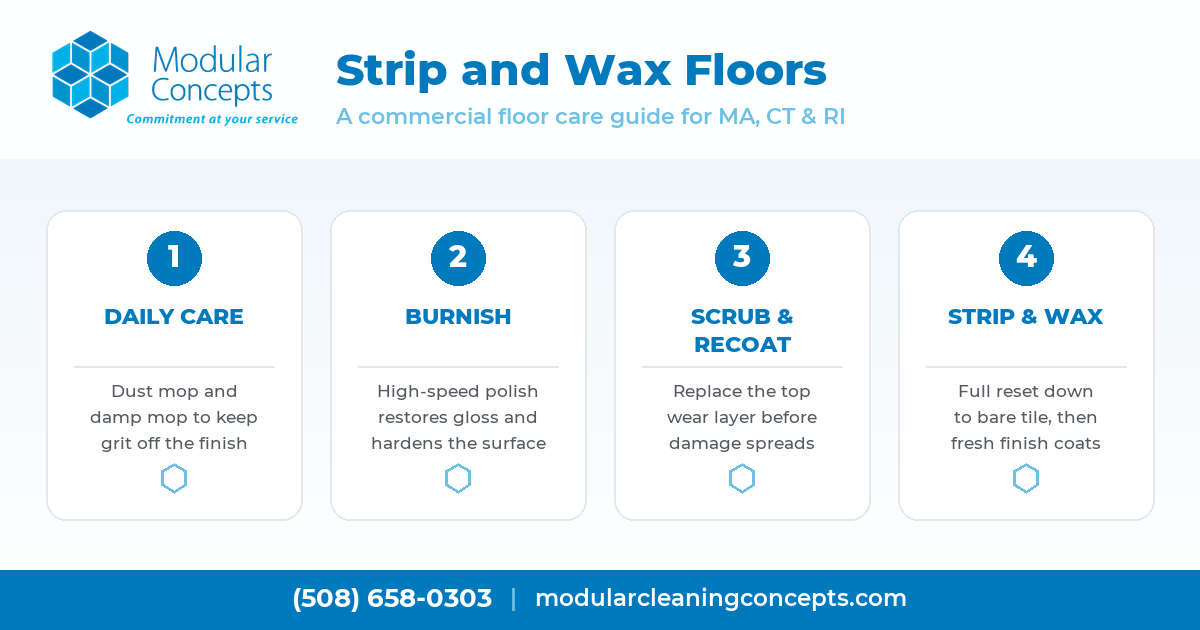
Floor care is a ladder with four rungs, and the point of the ladder is to climb to the top rung as rarely as possible. The bottom rung is daily care: dust mopping to remove grit, then damp mopping with a properly diluted neutral cleaner. This is the least glamorous work in the building and the most important, because grit is what saws through finish.
The second rung is burnishing: running a high-speed machine over the finish to restore gloss and harden the surface. The third is the scrub and recoat, where an auto-scrubber removes the top layer of finish along with its embedded scratches and soil, and one or two fresh coats go down. A scrub and recoat takes a fraction of the time of a strip-out, involves no harsh chemistry, and resets the wear layer before damage reaches the tile.
The top rung is the full strip and wax from section two, and it is a periodic reset, not the routine. Every scrub and recoat done on schedule pushes the next strip-out further away. Buildings that skip the middle rungs bounce between neglect and full strip-outs, which costs more in disruption and shortens the life of the tile. Buildings that work the ladder keep their floors presentable continuously. We are aware that holding strong opinions about mop grit is not normal. It is, however, the job.
4. How Often Should Commercial Floors Be Stripped and Waxed?
Frequency follows traffic and grit load, not the calendar alone. A building entrance in Hartford sees more abrasive traffic in one January week than a private office sees in a quarter, and the schedule should reflect that. The table below is the cadence most commercial facilities across Massachusetts, Connecticut, and Rhode Island land on.
| Task | Typical cycle | What it does |
|---|---|---|
| Dust mop and damp mop | Daily | Removes the grit that scratches finish |
| Burnishing | Weekly to monthly | Restores gloss and hardens the surface |
| Scrub and recoat | Quarterly to twice a year | Replaces the top wear layer |
| Full strip and wax, high traffic | Once or twice a year | Full reset down to bare tile |
| Full strip and wax, low traffic | Every one to two years | Avoids needless chemistry and downtime |
Two adjustments move the schedule. Matting is the first: a building with good walk-off matting at every entrance can often stretch each interval, because the mats catch grit before it reaches the finish. Season is the second: in this region the heaviest wear lands between November and March, which is why spring scrub and recoats and summer strip-outs are the standard rhythm, especially in schools and offices that empty out in July and August.
Treat these as starting points, not commandments. The honest way to set the schedule is to walk the building, look at the traffic lanes, and adjust twice a year. A vendor who quotes a strip-out frequency without looking at your floors is reading from a script, not from your building.
5. New England Is Hard on Floors: Salt, Sand, and Slush
Floor finish in this region dies in winter. From November through March, every person entering the building carries rock salt, sand, and slush on their boots, and the three attack the finish differently. Sand is an abrasive that grinds gloss off in traffic lanes. Slush carries dissolved salt deep into entryways. And salt is the worst of them: it clings to the finish as a white film that ordinary mopping smears around instead of removing, dulling the floor and slowly breaking the finish down.
The defense is layered and none of it is exotic. Walk-off matting at every entrance, long enough that people take several steps across it, catches most of the load. Entry zones get mopped more often in winter, with a neutral cleaner mixed correctly, because the strong alkaline cleaners that cut salt fastest also eat finish. When white residue keeps returning after mopping, a salt-neutralizing rinse pulls it out of the finish instead of pushing it around.
Then spring arrives and tells you how the winter went. The standard move across Massachusetts, Connecticut, and Rhode Island is a spring scrub and recoat on entries and main corridors to clear the salt damage and rebuild the wear layer, with the full strip-out saved for summer. Winter is also why two similar buildings can need very different floor programs: the one with a plowed, sanded parking lot tracks in far more abrasive than the one served by a paved garage.
6. Safety, Downtime, and Scheduling the Work
A floor care project is a controlled slip hazard, and it should be treated like one. Stripper solution is slippery by design, rinse water spreads, and fresh finish cannot be walked on. OSHA's walking-working surfaces rule, 29 CFR 1910.22, requires floors kept clean, orderly, and sanitary and maintained free of hazards such as spills, and it applies just as much during cleaning as after it. Wet floor signs, blocked-off sections, and a crew that controls access are not formalities. They are the difference between maintenance and an incident report.
Ventilation belongs on the same list. Strippers carry strong odors, and while low-odor chemistry exists, moving air during and after the job matters, especially in occupied buildings and medical settings. This is one reason strip-outs are night and weekend work almost everywhere: the building is empty, the floor can be closed section by section, and the smell is gone before Monday.
Plan the downtime honestly. A strip and wax is a multi-hour job per area, and the finish needs to dry between coats and harden afterward, so the schedule should name which areas close when and when furniture returns. A vendor who promises a full strip-out in an occupied hallway during business hours is describing a shortcut, and the finish will show which corners were cut within a month or two.
7. Why Floor Finishes Fail Early
If a floor looks worse three months after a strip-out than it should, the cause is usually on a short list. The most common is finish over a dirty or unstripped floor. Layers of new finish mopped over old, soiled finish build into a yellowed, cloudy base that no burnishing can fix. The trade calls this mop and glop, and it is why some floors look dirtier the more they are waxed.
The rest of the list is chemistry and patience. Harsh cleaners used for daily mopping dissolve a little finish every night and dull it within weeks. Recoating without a proper scrub leaves soil sandwiched between layers, so the new coat sticks to dirt instead of finish and fails from below. Rushed dry times between coats trap moisture that later shows up as haze or powdering. And dirty mops or pads drag grit across the wet finish, sealing scratches in rather than out.
None of these failures announce themselves at handoff, because a fresh strip-out looks glossy no matter how it was done. The differences appear over the following weeks, which is why floor care is a poor place for the lowest bid and a good place for references. Ask how last year's floors look this year. Our crews grade mop water the way other people grade coffee, and it turns out that level of fussiness is exactly what the finish requires.
8. The Honest Boundaries: What Strip and Wax Is Not
This is the part most blog posts skip. Strip and wax is a resilient-floor process: it belongs on vinyl composition tile, vinyl, and similar hard surfaces that take an acrylic finish. It is not the answer for every hard floor, and a vendor who says otherwise is selling a process, not a result.
Wood floors are a different trade entirely, with sanding and sealing done by flooring specialists. Polished concrete is likewise its own discipline, built on diamond grinding rather than applied finish. Modular Concepts covers hard-surface floor care, meaning VCT, tile, and epoxy, and we say so plainly rather than improvising outside it. Tile and grout in restrooms respond to a different process again, machine scrubbing and extraction, because grout holds soil in a way finish never will.
The other honest boundary is the tile itself. Finish protects flooring; it does not repair it. Tile that is cracked, curling at the edges, or lifting from the slab, or tile with moisture coming up from beneath, will not be saved by another strip-out, and fresh gloss on failed tile just highlights the damage. The right call at that point is replacement, and a floor care vendor should tell you so even though it costs them a strip-out. That honesty is a good test of everything else they have told you.
9. How to Vet a Floor Care Vendor
Floor care rewards specific questions. Ask about process: how they set dwell time, whether they rinse and neutralize before laying finish, and how many coats they apply and why. Ask about equipment, because a strip-out needs machines, wet vacuums, and burnishers, not a mop bucket and optimism. Ask how they protect baseboards, door frames, and furniture, and confirm that every person entering your building is insured and background-checked.
Then look at how they scope. A serious vendor walks the building before quoting, writes the program zone by zone with a frequency for each line, and builds the maintenance ladder into the plan rather than selling strip-outs alone. It is the same zone-by-zone discipline we described in our warehouse and industrial cleaning guide, applied to the front of the house. And ask for accounts they have kept for years, then check what those clients say now. Customer reviews tell you more about month twelve than any sales walkthrough tells you about month one.
This is how Modular Concepts approaches floor care across Massachusetts, Connecticut, and Rhode Island. We run a team of roughly 100 professionals, we are a BSCAI member, and we work without long-term contracts: service runs month to month after a three-month start, so the floors have to stay good for the account to stay ours. The owner stays involved in quality control through site visits, and every program we quote starts with a walkthrough of your building, never a square-footage guess over the phone.
10. The Bottom Line
A commercial floor program is simple to describe and easy to neglect: keep grit off the finish daily, rebuild the wear layer with scrub and recoats before damage reaches the tile, and save the full strip and wax for the reset it was designed to be. The finish is a consumable that protects an asset, and in New England the winter sets the schedule. Most buildings do not need more cleaning to get better floors. They need the right work, in the right order, on a schedule set by their own traffic lanes.
If you operate a commercial facility in Massachusetts, Connecticut, or Rhode Island and your floors have gone gray despite daily mopping, Modular Concepts can help. We are a BSCAI member, we work without long-term contracts, and our owner stays involved in quality control on client sites because that is how good floors stay good.
Reach us at (508) 658-0303 for a no-obligation walkthrough and quote. We will tell you honestly what your floors need, whether that is a full strip-out, a scrub and recoat, or a better daily routine, and what it should cost.
Frequently Asked Questions
How often should commercial floors be stripped and waxed?
High-traffic commercial floors typically need a full strip and wax once or twice a year, with scrub and recoat work quarterly to twice a year in between. Low-traffic areas can often go one to two years between strip-outs. Traffic, walk-off matting quality, and winter grit load move the schedule more than the calendar does, so set the frequency by looking at the traffic lanes, not by a fixed date.
Is floor wax actually wax?
No. Modern commercial floor finish is a liquid acrylic polymer that dries into a clear, hard protective film. The industry kept the word wax from the era when floors really were waxed, and the phrases strip and wax, floor finishing, and floor refinishing all describe the same process today: removing the old acrylic layers and applying new ones.
What is the difference between buffing, burnishing, and waxing?
Buffing and burnishing both polish the existing finish with a rotating machine, with burnishing running at much higher speeds to produce a deeper gloss and a harder surface. Neither adds material to the floor. Waxing, properly called applying finish, lays down new acrylic coats. A healthy program uses both: burnishing maintains the shine between coatings, and recoating replaces the wear layer as it thins.
How long does a floor stay out of service after a strip and wax?
Plan on the area being closed for the working shift while stripping, rinsing, and coating happen, since each coat of finish must dry before the next. Floors can usually take careful foot traffic later the same day, but the finish continues hardening for several days, so furniture, rolling loads, and burnishing wait. This is why most strip-outs run overnight or on weekends, so the building never feels the closure.
Can floors be stripped and waxed in winter?
Yes, though cold and humidity slow drying, and every open door brings salt and grit toward wet finish, so crews control entrances carefully. Many facilities in Massachusetts, Connecticut, and Rhode Island run a lighter winter routine instead: aggressive matting and neutral mopping through the salt months, a scrub and recoat in spring to repair the damage, and the full strip-out in summer.
Does Modular Concepts handle floor care in Connecticut and Rhode Island?
Yes. Modular Concepts provides strip and wax, scrub and recoat, burnishing, and daily floor maintenance for offices, medical buildings, schools, non-profits, and industrial facilities across Massachusetts, Connecticut, and Rhode Island. Programs are scoped from a free walkthrough, run without long-term contracts, and include the daily care that makes the periodic work last. Call (508) 658-0303 to schedule.
Sources
OSHA, 29 CFR 1910.22 Walking-Working Surfaces: General requirements