A local guide to office cleaning, tax rules & seasonal upkeep for Hartford, Connecticut buildings. Modular Concepts cleans commercial buildings across Massachusetts, Connecticut, and Rhode Island. Hartford is one of the more distinct markets in that footprint. The city runs on a mix of century-old insurance headquarters, state government buildings, and newer suburban office parks in West Hartford and Glastonbury. Each of those building types wears differently. A cleaning plan built for a glass tower in a Boston suburb does not automatically fit a prewar office block on Asylum Street. Hartford CT facility managers also deal with something their Massachusetts and Rhode Island counterparts do not. Connecticut taxes the cleaning contract itself. That detail changes how a facility budget gets built. It usually only shows up on the first invoice, after the contract is already signed. This guide covers that rule, the local building stock, and what a fair Hartford-area cleaning provider actually looks like. Quick Answer: Hartford CT facility managers should budget for Connecticut’s 6.35 percent sales tax on janitorial services. Massachusetts and Rhode Island do not charge that tax. Beyond the tax, cleaning needs split by building era. Downtown’s older insurance towers need more floor and stone care. Newer suburban offices in West Hartford and Glastonbury lean on daily upkeep and winter matting.
Table of Contents
- The Local Commercial Real Estate Landscape
- Common Facility Types in Hartford and Their Cleaning Needs
- The Cleaning-Specific Rule Connecticut Facility Managers Can’t Ignore
- Climate and Seasonal Factors Specific to the Region
- What to Look for in a Hartford-Area Cleaning Provider
- Service Response Times and What’s Reasonable for the Metro
- Comparing Hartford Quotes to the Rest of the Tri-State Market
- Notable Building Types and How Cleaning Differs
- How Modular Concepts Serves Hartford
- The Bottom Line
1. The Local Commercial Real Estate Landscape
Downtown Hartford is a tenant’s market right now. That shapes how buildings get maintained. Class A office towers in the core total roughly 6 million square feet across 13 buildings. They were sitting at an availability rate approaching 40 percent as of 2025, the fifth straight year of negative absorption downtown. Well known names like the Gold Building, CityPlace I on Asylum Street, and the Constitution Plaza towers have all reported vacancy well above that historic norm. A soft downtown market changes what a facility manager can ask a cleaning vendor for. A prospective tenant might tour three available buildings in one afternoon. The lobby floor and the restroom finish are doing real leasing work on that tour. Owners who once treated cleaning as background maintenance now treat it as part of the pitch. The suburban story looks different. West Hartford and Glastonbury are seeing lower vacancy and stronger effective rents. Leasing activity has concentrated in amenity-rich buildings in those towns. A facility manager in one of those newer buildings is often solving a different problem. The goal there is keeping a full building running smoothly, not making an empty one look leasable.
2. Common Facility Types in Hartford and Their Cleaning Needs
Hartford’s commercial base is not one type of building. Insurance and financial-services headquarters occupy the largest footprints downtown. Many have large lobby atriums, executive floors, and conference centers with uneven daily traffic. State and public-agency offices add another layer. They see heavier foot traffic during business hours and stricter after-hours access rules. Law firms, nonprofits, and healthcare-adjacent offices fill out the rest of the downtown core. Many of those offices are tied to the insurance industry’s claims and underwriting work. Each building type needs a different night cleaning window and a different day-porter presence. A one-size cleaning schedule built for a single-tenant suburban office rarely works downtown. Facility managers overseeing a downtown Hartford building often manage more common-area square footage per employee than their suburban counterparts do. Older buildings simply carry wider lobbies and longer corridors. That ratio is worth mentioning to any vendor quoting the job. It changes labor hours more than square footage alone suggests.
3. The Cleaning-Specific Rule Connecticut Facility Managers Can’t Ignore
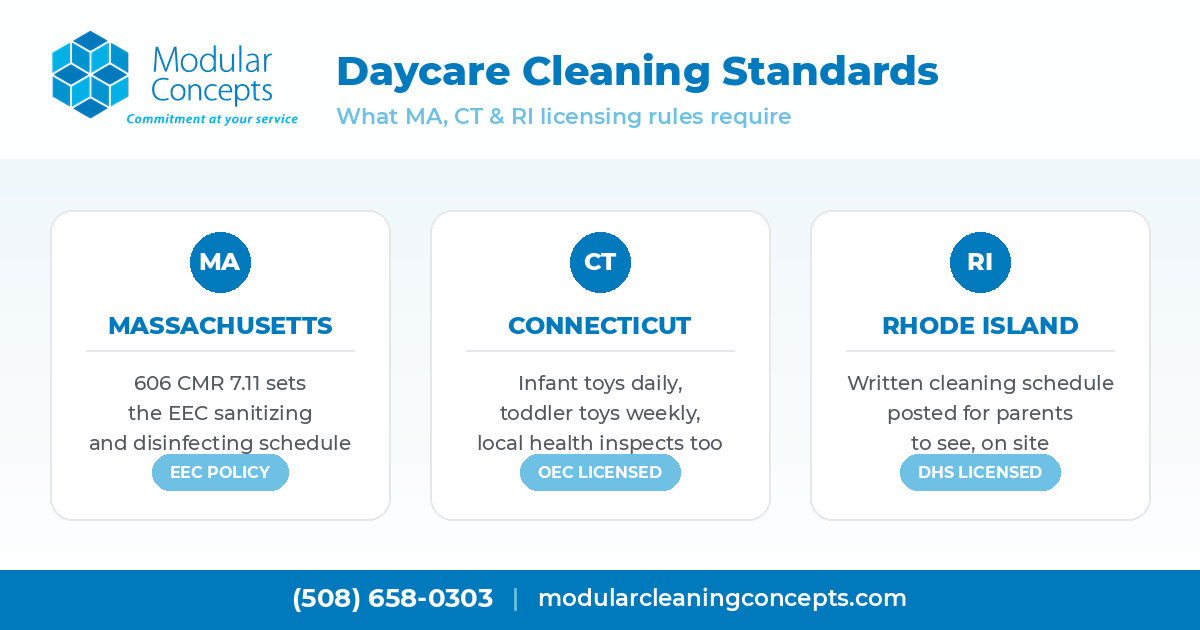
This is the part most blog posts about commercial cleaning skip. Connecticut charges sales tax on cleaning services themselves, not just on supplies. Conn. Gen. Stat. § 12-407 and the janitorial-services regulation at Conn. Agencies Regs. § 12-407(2)(i)(Y)-1 make cleaning a commercial building a taxable service in Connecticut. The current rate is the state’s flat 6.35 percent. Massachusetts and Rhode Island do not tax janitorial or commercial cleaning services this way. A facility manager might compare a monthly quote from a Hartford vendor against one from Worcester or Providence. Those two numbers are not equal unless the Hartford quote’s tax treatment is spelled out. The fix is simple. Ask a prospective Hartford vendor directly whether their quoted price includes Connecticut sales tax or adds it on top. A vendor who cannot answer that clearly on the first call has not quoted very many Connecticut jobs.
4. Climate and Seasonal Factors Specific to the Region
New England winters are hard on entryways. Hartford’s downtown foot traffic makes the problem worse than a suburban office with a private lot. State workers, bus and rail riders, and insurance-company staff all track in snow and salt. ISSA, the cleaning industry’s trade association, recommends at least 15 feet of scraper and wiper matting at every entrance. An effective matting system keeps up to 80 percent of moisture and soil from ever reaching interior floors. Winter service plans should also step up hot-water carpet extraction. Most carpet makers require it more often during salt-and-slush months to keep warranties intact. It also stops ice-melt chemicals from staining fibers. Daily vacuuming of entrances and main walkways, not weekly, is the baseline ISSA recommends once snow starts falling. None of this is glamorous work. Ask any floor technician which they would rather do on a February morning: restore a marble insurance-company lobby, or remop a slush-soaked vestibule for the third time before nine o’clock. You will get a very long answer.
5. What to Look for in a Hartford-Area Cleaning Provider
Hartford CT facility managers get the same standard we hold everywhere in our coverage area: BSCAI verified, no long-term contracts, and an owner who visits client sites as part of quality control. Those items are worth checking with any vendor you are evaluating. Connecticut adds one more to the list.
- BSCAI verification through the Building Service Contractors Association International, the industry’s primary credibility signal
- A month-to-month structure after an initial term, not a multi-year lock-in with an auto-renewal clause
- Direct experience quoting both older masonry buildings and modern glass office parks, since the labor and equipment needs differ
- A clear, written answer on whether Connecticut sales tax is included in the quoted price
- An owner or senior manager who actually walks the site, rather than only an account manager checking in by email
A vendor who hedges on any one of these is worth a second phone call before a first contract.
6. Service Response Times and What’s Reasonable for the Metro
Hartford sits at the junction of I-84 and I-91. That makes the metro area more compact than its sprawl on a map suggests. A same-day or next-morning response is a reasonable standard for a spill, a burst pipe, or an after-hours cleanup request. Distance on a map matters less than how many other Hartford-area accounts a vendor already services. A company running three other buildings within a few blocks of yours can turn a callout around faster than one commuting in from outside the metro. That is true no matter how the drive time looks on paper. Ask any prospective vendor how many current Hartford-area clients they service and where. The answer tells you more about realistic response time than any promise in a sales pitch.
7. Comparing Hartford Quotes to the Rest of the Tri-State Market
Base cleaning rates in Hartford generally track the same market logic as the rest of Massachusetts, Connecticut, and Rhode Island. That holds true by facility size and cleaning frequency. What changes is the layer on top. The Connecticut sales tax covered earlier applies no matter which vendor a facility manager chooses, since it is a state tax on the service, not a vendor markup. That means the fair way to compare a Hartford quote against a Boston-area or Providence-area quote starts with one step. Pull the base service cost apart from the tax treatment before drawing any conclusions. A Hartford number that looks higher at first glance may simply be tax-inclusive where the other quote is not. Any Hartford-area vendor should be able to break that out on request. If a quote arrives as one flat number with no breakdown, ask for the split before signing.
8. Notable Building Types and How Cleaning Differs
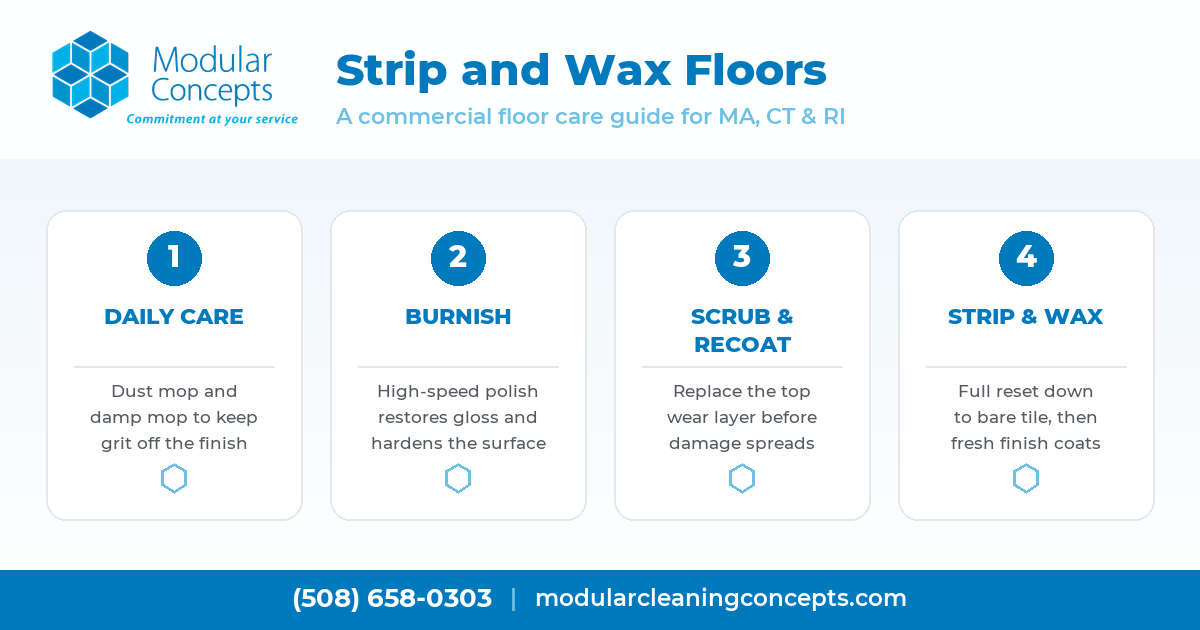
Hartford earned its nickname, the Insurance Capital of the World, in the 19th century. Companies including Aetna and Travelers built their headquarters in the city. Many of those buildings, and the ones built in their image downtown, still stand. Their lobbies and common areas carry terrazzo, marble, and other stone finishes. That is different from the vinyl composition tile common in newer construction. Stone floors are restored and polished, not stripped and recoated the way vinyl composition tile is. Treating stone like resilient flooring, or the reverse, is one of the more expensive mistakes a cleaning vendor can make in an older Hartford building. Our strip and wax floor care guide covers the resilient-floor side of that split in more detail. Newer buildings in West Hartford and Glastonbury lean toward large glazed curtain walls and open floor plans. Floors there mix carpet tile and VCT, which calls for a more standard maintenance plan built around scheduled recoats. A facility manager overseeing both an older downtown asset and a newer suburban one needs a vendor comfortable running two different floor programs at once.
9. How Modular Concepts Serves Hartford
Hartford sits inside our coverage area along with the rest of Massachusetts, Connecticut, and Rhode Island. Our crews are comfortable quoting the stone-floor programs that older downtown insurance towers need. They are just as comfortable with the more standard VCT and carpet tile programs that newer suburban buildings run. That range matters given how mixed Hartford’s building stock actually is. We also work with facilities along Hartford’s industrial and distribution corridor, where the cleaning scope looks different from a downtown office tower. See our full commercial cleaning services, or, for warehouse and distribution space, our warehouse and industrial cleaning guide. Both cover how we scope a building before quoting it. If you are still comparing cleaning models generally, our breakdown of janitorial services versus commercial cleaning is a useful starting point.
10. The Bottom Line
Hartford’s commercial cleaning market runs on the same fundamentals as the rest of the tri-state area. The one state-specific wrinkle is Connecticut’s tax on the service itself, and any fair quote should say so plainly. If you manage a commercial building in Hartford, or anywhere else in Massachusetts, Connecticut, or Rhode Island, Modular Concepts can help. We understand both the older stone-floor towers downtown and the newer suburban office parks. We are BSCAI verified, we work without long-term contracts, and our owner is on-site at client locations regularly because that is how good work gets done. Reach us at (508) 658-0303 for a no-obligation walkthrough and quote. We will tell you honestly what your Hartford building needs. We will tell you what it should cost, including the Connecticut tax, and how we would build the plan.
Frequently Asked Questions
Does Connecticut charge sales tax on commercial cleaning services? Yes. Connecticut taxes janitorial and cleaning services under Conn. Gen. Stat. § 12-407. The state’s standard rate is 6.35 percent. The specific rule for janitorial work is defined in Conn. Agencies Regs. § 12-407(2)(i)(Y)-1. Massachusetts and Rhode Island do not tax these services the same way. A Hartford quote and a Worcester quote are not directly comparable unless tax treatment is spelled out. How tight is Hartford’s downtown office market right now? Downtown Hartford’s Class A towers were reporting an availability rate approaching 40 percent as of 2025 reporting. That marks the fifth consecutive year of negative absorption. Suburban submarkets like West Hartford and Glastonbury are performing better, with lower vacancy and stronger effective rents. What OSHA rules apply to a private office building in Hartford? Federal OSHA standards apply here, the standards private employers in Massachusetts and Rhode Island follow too. Connecticut operates its own OSHA-approved state plan, but it covers only state and local government workers. Private-sector employers, including most commercial office buildings in Hartford, fall under federal OSHA jurisdiction. How much entrance matting does a Hartford lobby need in winter? ISSA, the cleaning industry’s trade association, recommends at least 15 feet of scraper and wiper matting at every entrance during winter months. An effective matting system can keep up to 80 percent of tracked-in moisture and soil out of the building. Does Modular Concepts serve Hartford CT facility managers directly? Yes. Hartford is part of Modular Concepts’ service area across Massachusetts, Connecticut, and Rhode Island. We quote both older downtown buildings with stone floor programs and newer suburban offices with more standard VCT and carpet maintenance. What is the biggest cleaning difference between an older Hartford tower and a newer suburban office? Floor material and floor program make the biggest difference. Older downtown buildings, many dating to Hartford’s rise as an insurance industry hub, often have terrazzo or marble that needs restoring and polishing. Newer buildings typically run vinyl composition tile or carpet tile on a scheduled strip-and-recoat or extraction cycle instead.
Sources
Occupational Safety and Health Administration, Connecticut State Plan overview: osha.gov/stateplans/ct. Connecticut Department of Revenue Services, Services Subject to Sales and Use Taxes: portal.ct.gov/drs/sales-tax. Connecticut Agencies Regulations § 12-407(2)(i)(Y)-1, Janitorial Services, via Cornell Law School’s Legal Information Institute: law.cornell.edu. ISSA, “Winter Carpet Care Calls for a Plan”: issa.com. Hartford Business Journal, “Tenant market to persist in 2026 as high vacancies temper Hartford’s modest office gains”: hartfordbusiness.com. Connecticut History (CTHumanities), “Aetna Helps Make Hartford ‘The Insurance Capital of the World'”: connecticuthistory.org.