A compliance guide for restaurant owners, facility managers & food-service operators across Massachusetts, Connecticut & Rhode Island.
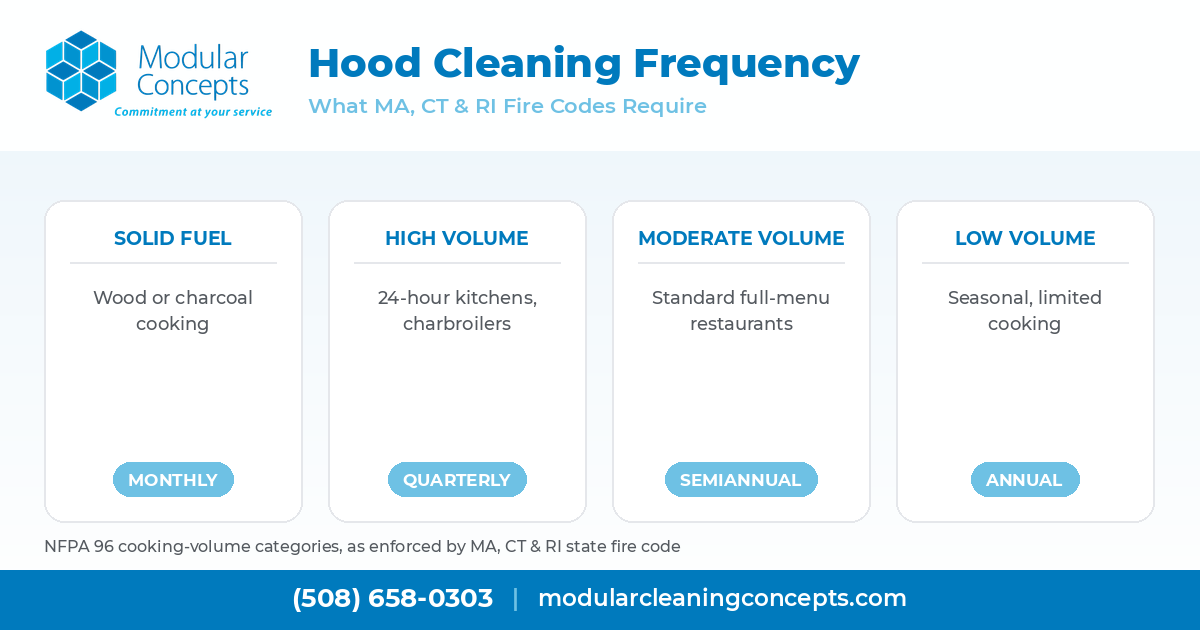
Quick Answer: Modular Concepts, a commercial cleaning company serving Massachusetts, Connecticut, and Rhode Island, answers this compliance question directly. NFPA 96 and each state’s fire code set the schedule. Solid-fuel cooking needs monthly service. High-volume operations like 24-hour kitchens or charbroilers need quarterly service. Standard full-menu restaurants need semiannual service, and low-volume kitchens need annual service. Only a licensed, trained cleaner can perform the work and sign off on it.
Kitchen hood cleaning frequency is not a housekeeping preference. It is a fire-code requirement, and the interval a restaurant or commercial kitchen has to meet depends on how much it cooks, what it cooks, and which state it operates in. This guide covers what the code requires for kitchens across Massachusetts, Connecticut, and Rhode Island.
Grease is the variable everything else follows. It builds up inside a kitchen exhaust system every time the hood runs, and it is one of the most common fuels behind commercial kitchen fires. The frequency table in this guide is not a suggestion pulled from an industry blog. It comes from NFPA 96 and the fire codes that Massachusetts, Connecticut, and Rhode Island have adopted to enforce it.
This guide covers the national NFPA 96 frequency categories, how each of the three states enforces them, what counts as a compliant clean, what proof a fire marshal or insurer expects to see, and where restaurant scope actually starts and stops.
Table of Contents
Why Hood Cleaning Frequency Is a Fire-Code Question
The NFPA 96 Frequency Table by Cooking Volume
Massachusetts: 527 CMR and the Fire Marshal License System
Connecticut: The State Fire Safety Code and Local Enforcement
Rhode Island: The Same NFPA Backbone, a Different Front Door
What “Clean” Actually Means
Proof of Compliance: Certificates, Tags, and Insurers
Restaurants Are Fully in Scope for Hood Cleaning
How to Vet a Hood Cleaning Vendor
The Bottom Line
1. Why Hood Cleaning Frequency Is a Fire-Code Question
Cooking is the leading cause of restaurant building fires. It causes 59 percent of them, according to a topical report from the U.S. Fire Administration built on national fire-incident data. Most of those are small, confined fires. The larger, more damaging fires tell a more specific story.
In the larger, nonconfined fires that same USFA analysis studied, failure to clean was a specific contributing factor in 12 percent of incidents. Grease or cooking oil was the material first ignited in most of the fires that started with cooking materials. Ducts themselves showed up as a fire’s area of origin in a measurable share of cases. That is exactly the space a hood cleaning frequency schedule is designed to keep clear.
None of that is abstract risk. It is why fire marshals in all three states treat hood cleaning frequency as an inspection item, not a courtesy. It is also why an insurer will ask for cleaning records after a claim rather than take a kitchen’s word for it.
2. The NFPA 96 Frequency Table by Cooking Volume
NFPA 96, the Standard for Ventilation Control and Fire Protection of Commercial Cooking Operations, sets inspection intervals by how much grease-laden vapor a kitchen produces, not by a flat calendar rule. The table below breaks down hood cleaning frequency by NFPA 96’s cooking-volume categories, as applied by state fire code.
| Cooking Volume | Inspection Frequency | Typical Kitchens | Example |
|---|---|---|---|
| Solid fuel | Monthly | Wood or charcoal-fired cooking | Wood-fired pizza, BBQ smokehouse |
| High volume | Quarterly | 24-hour or heavy-use kitchens | Charbroiler, wok station, diner |
| Moderate volume | Semiannually | Standard full-menu restaurants | Sit-down restaurant, cafeteria |
| Low volume | Annually | Seasonal or limited cooking | Church kitchen, camp, banquet hall |
Inspection and cleaning are two different steps. An inspection checks how much grease has built up. If the inspector finds contamination on interior surfaces, NFPA 96 requires that the contaminated sections of the system get cleaned, not spot-wiped, before the next scheduled inspection comes due. A kitchen that inspects on schedule but never triggers a cleaning is unusual. Most working kitchens end up on a cleaning cycle close to their inspection cycle.
Menu and equipment decide the category more than table seating does. A 200-seat kitchen doing salads and sandwiches can sit in the low-volume tier. A 40-seat kitchen running a wok station or charbroiler around the clock can land in quarterly or even monthly territory. The honest way to find out which category a kitchen falls into is to have a licensed inspector look at the actual cooking line.
3. Massachusetts: 527 CMR and the Fire Marshal License System
Massachusetts enforces hood cleaning frequency through the State Fire Code, 527 CMR 1.00, Chapter 50. Table 50.5.4 sets the same four cooking-volume categories covered above, running from monthly for solid fuel up to annual for low-volume kitchens like churches, camps, and seasonal facilities.
Who can legally do the work is its own layer of the rule. Massachusetts requires anyone performing hood cleaning or inspection to hold a certificate of competency from the State Fire Marshal. That certificate comes in two tiers. A Type 1 license holder can both inspect and clean. A Type 2 restricted license holder can only clean systems on their own property and cannot perform inspections for anyone else. A kitchen hiring an outside vendor should confirm which tier that vendor actually holds.
The label requirement closes the loop. 527 CMR 1.00, section 50.5.6.13, requires a dated certificate or tag with the servicer’s license number affixed to the system after each cleaning. That tag is exactly the record a fire inspector checks on a walkthrough.
4. Connecticut: The State Fire Safety Code and Local Enforcement
Connecticut regulates hood cleaning frequency through the Connecticut State Fire Safety Code, administered by the Office of the State Fire Marshal. The 2022 edition of that code is built on the 2021 edition of NFPA 1, the Fire Code. NFPA 1 incorporates NFPA 96 by reference for commercial cooking operations, so Connecticut kitchens follow the same cooking-volume categories used in Massachusetts and nationally.
Enforcement in Connecticut runs through local fire marshals, who inspect kitchens in their own jurisdictions and hold cleaning records against the NFPA 96 schedule. A kitchen operating across several Connecticut towns, common for multi-location restaurant groups, should expect the inspection cadence to vary slightly by local fire marshal. The underlying code, though, is statewide.
Connecticut’s demand for this work concentrates differently than Massachusetts. Connecticut runs two to three times Massachusetts’ search volume on commercial cleaning terms generally, and Modular Concepts treats Connecticut as a priority market for licensed kitchen hood and exhaust work, not an afterthought to its Massachusetts base.
5. Rhode Island: The Same NFPA Backbone, a Different Front Door
Rhode Island’s fire code, 450-RICR-00-00-7, incorporates the 2021 edition of NFPA 1 as the Rhode Island Fire Code. That is the same base edition Connecticut adopted. The Rhode Island Fire Safety Code Board of Appeal and Review oversees the code, and the State Fire Marshal enforces and interprets it.
NFPA 1 pulls in NFPA 96 for commercial cooking operations. That means a Providence restaurant and a Hartford restaurant work from the same underlying inspection and cleaning categories, even though the two states administer the paperwork through different agencies. The practical takeaway for a multi-state operator is that the technical requirement does not change at the state line. What changes is who signs off on it and which local authority holds the records.
Rhode Island kitchens should expect the same documentation expectations covered later in this guide: a dated service tag on the system and a certificate of performance the fire marshal or an insurer can ask to see without notice.
6. What “Clean” Actually Means
A compliant hood cleaning is not a wipe-down of the visible stainless steel. NFPA 96 requires the entire exhaust path, hood canopy, grease filters, ductwork, and the rooftop fan, to be cleaned to bare metal. That means every trace of grease film is physically removed, not masked.
This is where the industry’s biggest shortcut lives. A crew that sprays a degreaser over visible grease and calls it done has not performed a code-compliant clean, even if the hood looks shiny afterward. Real work means pulling filters, opening duct access panels, and reaching the fan housing. Coating residual grease with powder, or covering it with paint to hide it, fails the same standard, because the grease is still there and still fuel.
A kitchen should assume the duct interior and rooftop fan are part of every scheduled cleaning, not an occasional extra. Access panels exist specifically so a licensed cleaner can reach those sections, and a system without properly placed access panels is itself a code deficiency worth flagging to whoever installed it.
7. Proof of Compliance: Certificates, Tags, and Insurers
Every compliant hood cleaning ends with paperwork, and the paperwork is the point. A certified cleaner affixes a dated service tag to the system after each job, documenting who performed the work and when. Along with the tag, a reputable vendor provides a certificate of performance and before-and-after photos, which become the record a kitchen keeps on file.
That record matters to more than the fire marshal. Insurers ask for hood cleaning documentation after a kitchen fire claim. A gap in the service history can affect how a claim gets handled. A property manager leasing space to a restaurant tenant has the same interest. A fire that starts in a poorly maintained exhaust system rarely stays contained to one unit.
Keep the tags and certificates somewhere they will actually be found during an inspection, not in an inbox. A binder near the kitchen manager’s station, current for at least the last two service cycles, answers the question before it becomes a problem.
8. Restaurants Are Fully in Scope for Hood Cleaning
Restaurants are the single largest source of hood cleaning demand in the region, and Modular Concepts is licensed to serve them. The scope is specific. Modular cleans the hood, filters, ductwork, and exhaust fan for any commercial kitchen, including restaurants, schools, hospitals, corporate cafeterias, senior living facilities, and country clubs.
What is not included is the rest of a restaurant’s front-of-house footprint. Dining rooms, bars, restrooms, and kitchen floors fall outside this service. A restaurant hiring Modular for hood cleaning is hiring exactly that. It is exhaust-system compliance work performed by a licensed crew, scoped to the equipment the fire code actually regulates.
That distinction matters. Plenty of vendors either overpromise a full-kitchen clean they cannot legally certify, or refuse restaurant work outright to avoid the licensing requirement. Neither is the right answer for an operator trying to stay compliant. The right vendor cleans the hood system to code, documents it, and is straightforward about where the job ends.
9. How to Vet a Hood Cleaning Vendor
Ask for the license first. In Massachusetts, that means confirming a Type 1 certificate of competency if the vendor is also doing the inspection, or a Type 2 if they are cleaning only. In Connecticut and Rhode Island, ask which local fire marshal they work with regularly. Also ask whether they can produce past service tags from other accounts as a reference.
Ask what bare metal actually looks like on their invoice. A vendor should describe pulling filters, accessing ductwork, and cleaning the rooftop fan as standard steps, not upsells. If a quote sounds like a wipe-down price, it probably is one.
This is how Modular Concepts approaches kitchen hood work across Massachusetts, Connecticut, and Rhode Island. We are licensed for commercial kitchen hood and exhaust cleaning. We work without long-term contracts, and our owner stays involved in quality control through site visits. The scope we quote comes from looking at the actual cooking line, not a guess over the phone. See our full range of commercial cleaning services for the rest of what we cover in a building.
10. The Bottom Line
Hood cleaning frequency is not negotiable once a kitchen knows its cooking-volume category. NFPA 96 sets the schedule, Massachusetts, Connecticut, and Rhode Island each enforce it through their own fire code, and the paperwork proves it happened.
If you operate a restaurant or any commercial kitchen in Massachusetts, Connecticut, or Rhode Island, Modular Concepts can help. We can tell you exactly where your exhaust system stands. We are licensed for commercial kitchen hood and exhaust cleaning, and we work without long-term contracts. Our owner is involved in quality control because that is how compliance work gets done right.
Reach us at (508) 658-0303 for a no-obligation walkthrough and quote. We will tell you honestly which frequency category your kitchen falls into, what it should cost, and what documentation you should be keeping.
Frequently Asked Questions
How often does a commercial kitchen hood need to be cleaned?
Hood cleaning frequency depends on cooking volume under NFPA 96. Solid-fuel cooking needs monthly service, high-volume operations like 24-hour kitchens or charbroilers need quarterly service, standard full-menu restaurants need semiannual service, and low-volume kitchens need annual service. Massachusetts, Connecticut, and Rhode Island all enforce these categories through their state fire codes.
Is restaurant hood cleaning required by law in Massachusetts, Connecticut, and Rhode Island?
Yes. All three states enforce kitchen exhaust cleaning through their state fire codes. Massachusetts uses 527 CMR 1.00 Chapter 50. Connecticut and Rhode Island both build their fire codes on the 2021 edition of NFPA 1, which incorporates NFPA 96 for commercial cooking operations. Local fire marshals inspect against these schedules.
What happens if a restaurant skips a scheduled hood cleaning?
A kitchen that misses its inspection or cleaning interval risks a fire marshal citation. Grease accumulation left unaddressed is a documented factor in commercial kitchen fires. Insurers also ask for hood cleaning records after a fire claim, and a gap in that record can complicate how the claim is handled.
Can restaurant staff clean the exhaust hood themselves?
No. NFPA 96 requires hood cleaning to be performed by a trained, certified individual or company acceptable to the local fire authority. In Massachusetts specifically, cleaners must hold a certificate of competency from the State Fire Marshal. That is either a Type 1 license to inspect and clean, or a Type 2 restricted license to clean systems on their own property only.
What is the difference between a hood inspection and a hood cleaning?
An inspection checks how much grease has accumulated inside the exhaust system and determines whether a cleaning is due. A cleaning physically removes that grease from the hood, filters, ductwork, and fan down to bare metal. Kitchens are inspected and cleaned on the same cooking-volume-based schedule, but they are two distinct, separately documented steps.
Does Modular Concepts clean restaurant kitchen hoods in Connecticut and Rhode Island?
Yes. Modular Concepts is licensed for commercial kitchen hood and exhaust cleaning for restaurants and any other commercial kitchen across Massachusetts, Connecticut, and Rhode Island. Service covers the hood, filters, ductwork, and exhaust fan, scoped from a walkthrough of the actual cooking line. It runs without long-term contracts. Call (508) 658-0303 to schedule.
Sources
National Fire Protection Association, NFPA 96: Standard for Ventilation Control and Fire Protection of Commercial Cooking Operations: nfpa.org/96.
Massachusetts Executive Office of Public Safety and Security, Commercial Cooking Exhaust System Inspections and Hood Cleaning (527 CMR 1.00, Chapter 50): mass.gov.
Connecticut Department of Administrative Services, Office of the State Fire Marshal, CT Fire Safety and Prevention Codes: portal.ct.gov.
Rhode Island Department of State, Fire Code (450-RICR-00-00-7): rules.sos.ri.gov.
U.S. Fire Administration, Topical Fire Report Series, Volume 12, Issue 1: Restaurant Building Fires (NFIRS 2007-2009 data), April 2011: usfa.fema.gov.