A practical guide for childcare directors & facility managers across Massachusetts, Connecticut & Rhode Island.
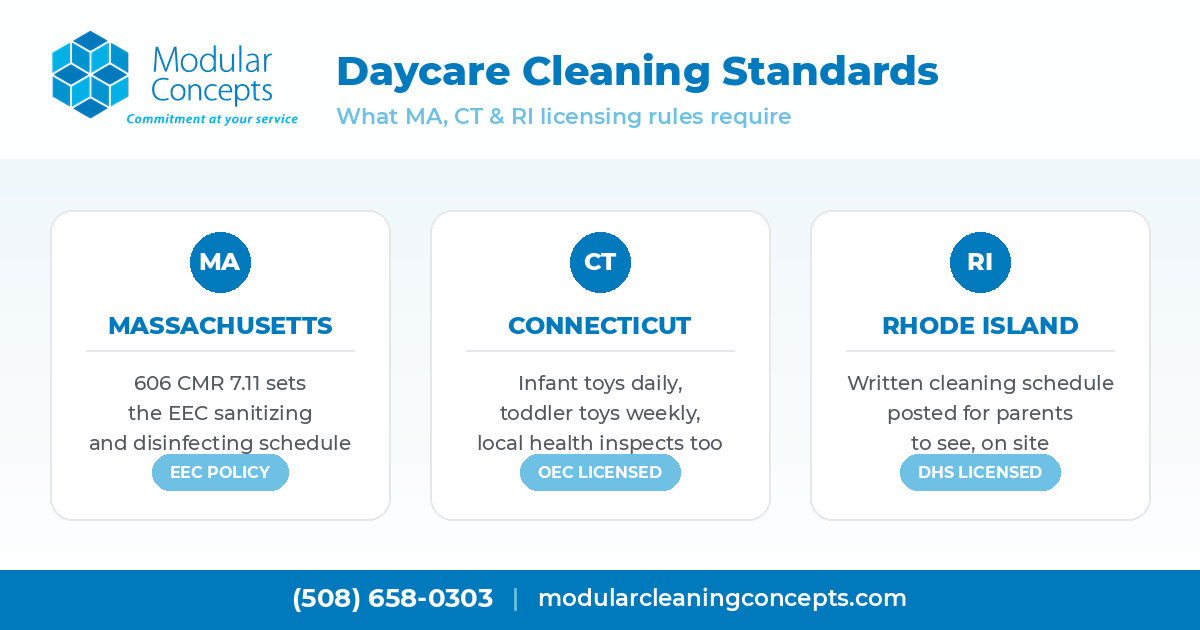
Quick Answer: Daycare cleaning standards come from state licensing rules, not one national rule. Massachusetts, Connecticut, and Rhode Island each require diapering surfaces cleaned and disinfected after every use. Food surfaces must be cleaned and sanitized before and after each use, with EPA-registered products only. Massachusetts and Connecticut also set specific toy-sanitizing frequencies. Rhode Island requires a written cleaning schedule posted where parents can see it.
Modular Concepts is a commercial cleaning company based in Marlborough, Massachusetts, and it services licensed daycare and preschool programs across Massachusetts, Connecticut, and Rhode Island. Directors ask one question more than any other: what does the state actually require? A daycare classroom gets cleaned to a standard a general office never has to meet. The reason is regulatory, not aesthetic.
State licensing agencies in all three states tie a program’s ability to operate directly to how it handles diapering surfaces, mouthed toys, and food-contact areas. The honest answer depends on which state a program is licensed in. The specific frequency rules differ more than most operators expect. This guide walks through what Massachusetts, Connecticut, and Rhode Island each require. It also covers the national standard those state rules are built on, and where the highest-risk zones in any childcare facility actually sit.
None of this is theoretical for a program that gets inspected. A surveyor who finds a diapering table with no documented routine can write a deficiency. So can toys that clearly have not been washed in weeks. That deficiency follows the program’s file. Getting daycare cleaning standards right the first time costs far less than fixing them after a citation.
Table of Contents
- Why Daycare Cleaning Runs on a Different Standard
- Massachusetts: The EEC Policy Behind 606 CMR 7.11
- Connecticut: Office of Early Childhood Rules and Local Health Inspections
- Rhode Island: A Written Schedule Is Not Optional
- The National Standard All Three States Build On
- High-Touch Surfaces and Toys: What Needs Daily Attention
- Diapering and Food Service: The Two Zones With No Room for Error
- Choosing Disinfectants Safely Around Children
- What to Look for in a Childcare Cleaning Vendor
- The Bottom Line
Frequently Asked Questions
1. Why Daycare Cleaning Runs on a Different Standard
Cleaning a daycare is not a smaller version of cleaning an office. Infants and toddlers explore with their hands and mouths. They spend hours a day at floor level, and their immune systems are still developing. A germ load an adult handles without notice can send a two-year-old home sick. That illness then spreads through the whole classroom.
Licensing makes the stakes concrete. A commercial office that skips a week of vacuuming faces no regulatory consequence. A licensed child care center in Massachusetts, Connecticut, or Rhode Island is different. A program that cannot show a working sanitation routine risks a licensing deficiency. In a serious case, it risks the license itself. Cleaning is not a housekeeping line item in this industry. It is part of the program’s legal standing to operate.
That is the frame for the rest of this guide. Daycare cleaning standards are not a best-practice suggestion. They are a compliance requirement written into state regulation. The three states in Modular Concepts’ service area do not all write that requirement the same way.
2. Massachusetts: The EEC Policy Behind 606 CMR 7.11
Massachusetts regulates child care sanitation through 606 CMR 7.11(10)(f) through (p). The Department of Early Education and Care enforces it. The rule sets the requirement in general terms. Equipment, materials, and the environment must stay sanitary.
Any product used to sanitize or disinfect has to be a bleach solution or a commercial product registered with the EPA as a sanitizer or disinfectant.
EEC’s own policy, effective April 2021, turns that rule into a schedule programs can actually follow. It splits three terms apart: cleaning removes dirt and debris with detergent and water. Sanitizing reduces germs to a level public health codes consider safe. Disinfecting destroys most germs on a surface. Those definitions build directly on the national Caring for Our Children standard, covered in section 5 below.
The policy sets practical rules Massachusetts programs get tripped up on. Sponges cannot be used for sanitizing or disinfecting. Solutions must air dry for the labeled contact time, at least two minutes if the label lists none. Bleach dilutions must be mixed fresh every 24 hours. A program that mixes a bleach solution once a week and keeps reusing it fails daycare cleaning standards, even if the ratio was correct on day one.
3. Connecticut: Office of Early Childhood Rules and Local Health Inspections
Connecticut splits enforcement between the state and local government. Massachusetts and Rhode Island do not work this way. The Office of Early Childhood licenses child care centers and group child care homes. Connecticut General Statutes Section 19a-82 also requires local health departments to run their own environmental inspections of licensed child day care operations. A Hartford-area program answers to two different inspectors, not one.
Connecticut’s toy rule is more specific than most operators expect, and it treats age groups differently. Under Connecticut Administrative Code Section 19a-79-10, infant toys must stay separate from other toys. They need washing and sanitizing at least daily. Toddler toys, including floor and riding toys, only need washing and sanitizing at least weekly and as needed. A program that mixes infant and toddler toy bins is quietly failing the stricter of the two rules.
Diapering carries its own physical-plant rule. Connecticut centers need a sink with hot and cold running water set aside for diaper changing and handwashing. That sink must stay separate from any food-preparation sink. The separation is not a suggestion. It is how the state stops a diapering accident from becoming a kitchen contamination event.
4. Rhode Island: A Written Schedule Is Not Optional
Rhode Island’s Department of Human Services licenses child care centers, family child care homes, and group family child care homes under regulation 218-RICR-70-00-1. Section 1.9(G) requires every licensed program to post its cleaning and sanitation schedule where parents and visitors can see it, with a plan for deep cleaning. A program with no written, posted schedule is out of compliance before an inspector even checks the cleaning itself.
The specifics under that same section are concrete. Eating tables, feeding seats, and high chair trays need sanitizing before and after every meal and snack. Sensory water tables must be emptied and sanitized daily, not refreshed and reused across groups. Reusable sponges and dish cloths are barred outright for cleaning or sanitizing. Massachusetts applies that same restriction.
Diapering surfaces must be cleaned and sanitized after each use under Section 1.10(B)(7). Every cleaning or sanitizing product used in a Rhode Island program needs EPA registration, applied exactly as the label directs. Outdoor toys and playground equipment follow CDC guidance and need cleaning between groups. That is one of the few places any of the three states names a federal agency directly in its own rule.
5. The National Standard All Three States Build On
Massachusetts, Connecticut, and Rhode Island each write their own rules. None of them invented their cleaning science from scratch. All three lean on Caring for Our Children, the national health and safety standards for early care and education. The American Academy of Pediatrics and the American Public Health Association publish it jointly. The National Resource Center for Health and Safety in Child Care and Education maintains it online. Massachusetts cites the fourth edition by name in its own EEC policy.
Caring for Our Children is where the cleaning, sanitizing, and disinfecting definitions in all three states actually come from. It also supplies the item-by-item frequency table state policies get built around. The table below reflects the schedule Massachusetts’ EEC policy publishes, based on that national standard. A program in any of the three states can use it as a working baseline, then layer each state’s specific rules on top.
| Item | Action Required | Frequency |
|---|---|---|
| Diapering surfaces | Cleaned and disinfected | After each use |
| Toys mouthed by infants/toddlers | Cleaned and sanitized | After each use |
| Eating and food-prep surfaces | Cleaned and sanitized | Before and after each use |
| Toilets and toileting surfaces | Cleaned and disinfected | At least daily |
| Cribs, cots, and sleeping mats | Cleaned and sanitized | Weekly, and before use by another child |
| Floors, sinks, drinking fountains | Cleaned and sanitized | At least daily |
Two categories deserve a second look, because they carry zero tolerance for drift. Diapering surfaces are one. Anything touched during a bodily-fluid cleanup is the other. Both move straight to disinfecting rather than the lighter sanitizing standard used almost everywhere else in the building.
6. High-Touch Surfaces and Toys: What Needs Daily Attention
A daycare classroom packs in more high-touch surfaces per square foot than almost any other space Modular Concepts services. Door handles, cubby fronts, light switches, faucet handles, and sensory-bin rims get touched by every child, many times an hour. Toddlers are still building the hand hygiene habits that would otherwise limit spread.
Toys mouthed by infants and toddlers sit at the top of the daily list in every state’s rules. Saliva transfers germs directly and often. Machine-washable fabric toys and bedding follow a looser rule: cleaned before use by another child, and at least weekly. Fabric does not carry the same risk as a hard plastic toy going straight from one mouth to the next child’s hands.
Floors deserve their own mention. Infant and toddler classrooms spend far more time at floor level than any office ever does. Smooth, non-porous floors need sweeping or vacuuming, then sanitizing, at least daily in programs serving infants or toddlers. That is tighter than the weekly floor-washing some states allow for short-hour programs with no infants or toddlers enrolled.
7. Diapering and Food Service: The Two Zones With No Room for Error
Every state in this guide treats diapering and food service as the two zones where a lapse creates the fastest path to an outbreak. Both get the same answer: clean, then disinfect or sanitize, after every single use. There is no exception for a slow afternoon.
The two zones also cannot share equipment. Massachusetts and Rhode Island both bar reusable sponges from any sanitizing or disinfecting work. Connecticut requires a diapering sink that stays physically separate from the food-prep sink. The logic is the same across all three states. A cloth or a sink that touches both zones turns one contamination event into two.
Standard Precautions apply the moment blood, vomit, or another bodily fluid is involved. Massachusetts’ EEC policy calls for gloves and the stronger disinfecting solution here, not the everyday sanitizing dilution. A program that treats a routine diaper leak the same as a bodily-fluid spill, using the same solution and the same gloves-optional habit, is treating two different risk levels as one.
8. Choosing Disinfectants Safely Around Children
Every product used to sanitize or disinfect in a licensed Massachusetts, Connecticut, or Rhode Island program needs EPA registration. That is not a brand preference. It is a licensing requirement in all three states. The registration number on the label is what a program checks against the EPA’s own product database if a surveyor asks for proof.
Contact time matters as much as the product. A disinfectant has to stay wet on the surface for the time listed on its label, generally at least two minutes if none is specified, before it is wiped or air dries. Wiping a surface dry the moment it looks clean, before that time passes, is one of the most common ways a program thinks it disinfected and actually did not.
Ventilation and timing protect the children in the room. Products should go down when children are not in the immediate area, with fresh air brought in until the surface dries. Respiratory sensitivity in young children is a documented concern with both bleach and non-bleach disinfectants used in occupied spaces. Modular Concepts applies EPA-registered products to this same standard in every childcare facility it services, and never claims performance a program’s own documentation cannot support.
9. What to Look for in a Childcare Cleaning Vendor
A vendor who has never worked inside a licensed program will not automatically know a Connecticut toddler toy bin runs on a different schedule than an infant one. They may not know Rhode Island wants the schedule posted on a wall. Ask a prospective vendor directly whether they have served licensed programs before. Ask them to name the specific licensing agency, EEC, OEC, or DHS, they worked under.
Ask what is actually on their cleaning cart. A vendor should name the EPA registration numbers of the products they bring into a classroom, without hesitation. They should explain their contact-time practice in plain language. If a vendor cannot describe the difference between sanitizing and disinfecting unprompted, they are not ready for a licensed classroom.
This is the standard Modular Concepts holds itself to across every childcare and preschool program it services in Massachusetts, Connecticut, and Rhode Island. We are BSCAI verified. Every person who enters a client site is background-checked, and our owner stays personally involved in quality control. A diapering table and a snack table sitting ten feet apart leave no room for inconsistent service. See our full range of commercial cleaning services, or how we approach daily janitorial service, for the rest of what we cover in a building. We work without long-term contracts, so the standard has to hold every month, not just the first one.
10. The Bottom Line
Daycare cleaning standards are not the same in Massachusetts, Connecticut, and Rhode Island. The underlying goal is identical in all three. Keep diapering and food zones under a strict after-each-use routine. Keep high-touch surfaces and mouthed toys on a daily cycle. Use EPA-registered products applied the way the label actually requires.
If you direct or manage a licensed child care or preschool program anywhere in Massachusetts, Connecticut, or Rhode Island, Modular Concepts can help you build and hold that schedule. We are BSCAI verified, our staff is background-checked, and our owner stays personally involved in quality control. A childcare classroom does not get a second chance at an inspection.
Reach us at (508) 658-0303 for a no-obligation walkthrough and quote. We will tell you honestly what your program needs, what it should cost, and exactly how the schedule we build maps to your state’s licensing requirements.
Frequently Asked Questions
How often should toys be sanitized in a daycare? Toys mouthed by infants and toddlers need cleaning and sanitizing after each use in Massachusetts and Rhode Island. Connecticut sets a different bar for children under three. Infant toys need washing and sanitizing at least daily. Toddler toys, including floor and riding toys, only need weekly washing and sanitizing plus attention as needed. Machine-washable fabric toys follow a looser weekly cycle in all three states, since they carry less contamination risk than hard plastic toys.
What does Massachusetts require for daycare cleaning? Massachusetts enforces child care sanitation under 606 CMR 7.11(10)(f) through (p), backed by a detailed EEC policy. It sets specific frequencies: diapering surfaces cleaned and disinfected after each use, food and eating surfaces cleaned and sanitized daily before and after use, and toilets cleaned and sanitized at least daily. Every sanitizing or disinfecting product must be a bleach solution or an EPA-registered commercial product.
Does Connecticut inspect daycare centers for cleanliness? Yes, through two separate channels. The Office of Early Childhood licenses and oversees child care centers and group child care homes statewide. Connecticut General Statutes Section 19a-82 separately requires local health departments to run their own environmental inspections of licensed child day care operations. A Connecticut program can be reviewed by both the state licensing agency and its local health department.
What cleaning products are safe to use around children in daycare settings? Massachusetts, Connecticut, and Rhode Island all require any sanitizing or disinfecting product used in a licensed program to carry EPA registration, applied exactly as the label directs. Products should stay out of children’s reach, never stored in beverage containers, and applied when children are not in the immediate area. The surface should air dry for the labeled contact time before children return to it.
How often must diapering surfaces be cleaned in a licensed daycare? After every single diaper change, in all three states. Massachusetts, Connecticut, and Rhode Island each require diapering surfaces cleaned and then disinfected, not just sanitized, after each use. Diapering carries a higher contamination risk than most other surfaces in a child care facility. Connecticut also requires a dedicated diapering sink, physically separate from any food-preparation sink.
Does Modular Concepts clean daycare and preschool facilities in MA, CT, and RI? Yes. Modular Concepts services licensed daycare and preschool programs across Massachusetts, Connecticut, and Rhode Island. We build cleaning schedules around each state’s specific licensing requirements for diapering areas, food-service surfaces, and toy sanitation. Service uses EPA-registered products, runs without long-term contracts, and includes owner-involved quality control. Call (508) 658-0303 to schedule a walkthrough.
Sources
Massachusetts Department of Early Education and Care, “Cleaning, Sanitizing, and Disinfecting Surfaces in Child Care Settings” policy (effective April 15, 2021).
606 CMR 7.00, Department of Early Education and Care licensing regulations, Massachusetts Secretary of the Commonwealth.
Connecticut Office of Early Childhood, Statutes and Regulations for Child Care Centers and Group Child Care Homes.
Connecticut Administrative Code, Section 19a-79-10, Under Three Endorsement.
Rhode Island, Child Care Center and School Age Program Regulations for Licensure, 218-RICR-70-00-1.
American Academy of Pediatrics, American Public Health Association, and National Resource Center for Health and Safety in Child Care and Education, Caring for Our Children: National Health and Safety Performance Standards (4th ed.).
Centers for Disease Control and Prevention, Hand Hygiene in Schools and Early Care and Education Settings.