A practical breakdown for facility managers across MA, CT & RI.
The three terms get used interchangeably on cleaning vendor brochures, in public-health guidance, and in everyday conversation, but they refer to different processes with different goals, different products, and different success criteria. Treating them as synonyms is what causes facility managers to overpay for unnecessary services, or to under-spec a job and leave a real problem in place.
The federal definitions matter because they drive what a vendor can legally claim, what products carry which labels, and what counts as work completed. The EPA, CDC, and OSHA all draw clean lines between these processes. Most professional cleaning programs use all three in different parts of a building on different schedules.
This post breaks down what each one actually does, when each is the right level of effort, and how to spec the right mix for an office, medical practice, or industrial facility in Massachusetts, Connecticut, or Rhode Island. The goal is to give you enough to read a scope of work and a vendor quote and know whether what you are being sold matches what you actually need.
Table of Contents
- Cleaning: What It Actually Does
- Sanitizing: What It Actually Does
- Disinfecting: What It Actually Does
- Side by Side: Where They Overlap and Where They Diverge
- When Routine Cleaning Is Enough
- When Sanitizing Is the Right Level
- When Disinfection Is Warranted
- Common Misconceptions About the Three Terms
- What to Ask a Vendor (and What Answers to Expect)
- The Bottom Line
1. Cleaning: What It Actually Does
Cleaning is the physical removal of dirt, debris, dust, and visible soil from surfaces. The EPA defines it as the use of soap (or detergent) and water to lift contamination off a surface so it can be rinsed or wiped away. Cleaning does not destroy germs on its own. It removes them along with the dirt and oils they cling to, and reduces their numbers on the surface as a side effect of the physical action.
In a commercial facility, this is the work that fills the daily and weekly portions of every cleaning schedule. Vacuuming carpet, mopping hard floors, wiping desks, dusting horizontal surfaces, emptying trash, cleaning glass. All of it is cleaning. The success criterion is visible: the surface looks and feels clean, the dust is gone, the spots are out.
What makes cleaning a real skill rather than just labor is technique. Microfiber color-coding so the same cloth that wiped a restroom doorknob never touches a conference table. Top-down progression in a room so dust falls onto surfaces that get cleaned later, not earlier. Using the right pH for the surface (neutral on sealed stone, alkaline on grease, acidic on mineral deposits). These small operational habits separate a competent crew from one that just moves dirt around.
For most commercial spaces, including offices, education buildings, and co-working, cleaning done well is the foundation. Sanitizing and disinfection sit on top of it, not in place of it. You cannot disinfect a dirty surface effectively, because the chemical cannot reach the germs through the layer of soil.
2. Sanitizing: What It Actually Does
Sanitizing is a step beyond cleaning. It uses chemical agents (or in some cases, heat) to reduce the number of microorganisms on a surface to a level public-health standards consider safe. The EPA and FDA define what level safe means, and the threshold varies depending on whether the surface contacts food, skin, or general environmental contact.
In a commercial setting, sanitizing shows up most often in food-prep areas: break-room counters, kitchenettes, employee cafeteria surfaces, dishwashing equipment. It also appears in places like daycare and education facilities, where toys, table surfaces, and shared equipment get sanitized between uses. The product is a sanitizer (look for the word on the label and the EPA registration number), and the process typically involves a wet contact time, then a wipe or rinse.
Sanitizing is not disinfection. The products are different, the contact times are different, and the regulatory thresholds are different. A sanitizer reduces germs to a defined safer level. A disinfectant goes further, and is intended (per its label) to destroy or inactivate them on the surface. Vendors who use the words interchangeably either do not understand the distinction or are intentionally blurring it, and either way it is a signal to ask for the actual product labels.
For most commercial offices, sanitizing is a targeted task, not a building-wide one. The break-room counter gets sanitized daily. The restroom grab bars and the open-plan desks get cleaned daily, and on a separate cadence, disinfected on their high-touch points.
3. Disinfecting: What It Actually Does
Disinfection is the use of EPA-registered chemical products designed (per their labels) to destroy or inactivate germs on hard, non-porous surfaces. The EPA registers these products and requires manufacturers to back label claims with testing. Every disinfectant has a specified contact time, sometimes called dwell time, that the product must remain visibly wet on the surface to be effective. That contact time is the single most misunderstood spec in commercial cleaning.
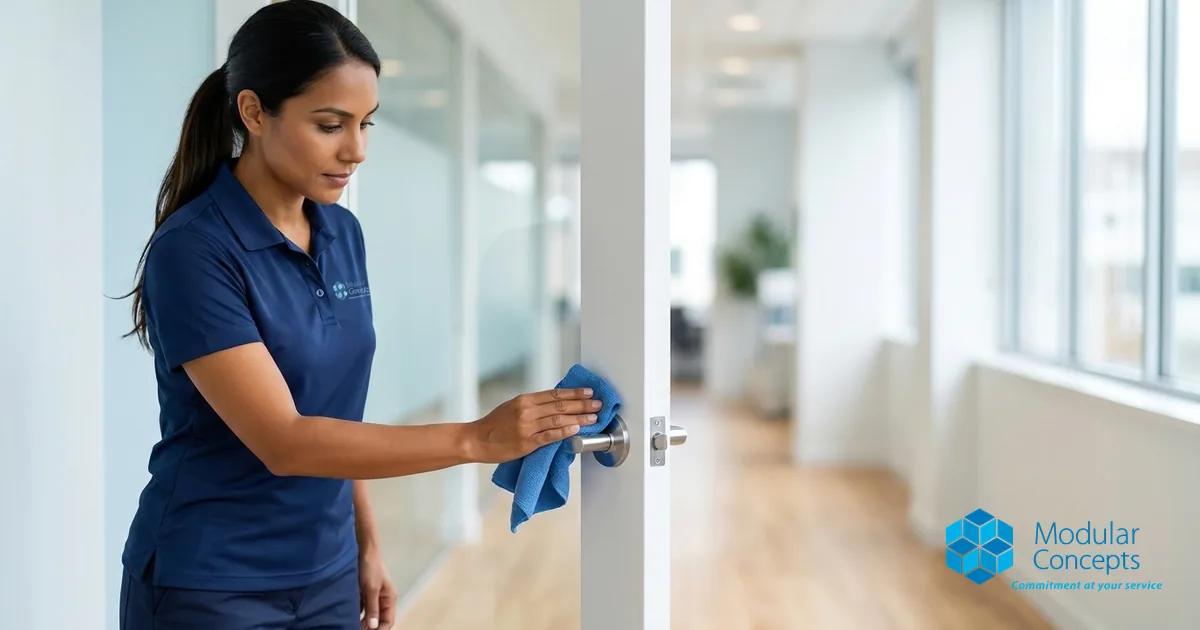
In a real-world program, disinfection lives on a smaller list of high-touch surfaces than most clients assume. Door handles and push plates, light switches, elevator buttons, shared keyboards and phones, restroom flush handles, faucet handles and dispensers, refrigerator handles in the break room. These are the surfaces where a contaminated touch transfers to another person hand within minutes. Disinfecting them daily, in the right way, is the work that actually reduces transmission risk in an office building.
Process matters as much as product. Wiping with a disinfectant for a few seconds and moving on does not disinfect. The product needs to be applied, the surface needs to stay wet for the contact time listed on the label (often 1 to 10 minutes), and only then is the surface considered disinfected. Most failed disinfection in commercial buildings is not a product problem. It is a process problem: not enough product applied, contact time skipped, or the surface wiped dry too soon.
Disinfection also requires a clean surface to start. Trying to disinfect through a layer of dust, grease, or biofilm is essentially decorative.
4. Side by Side: Where They Overlap and Where They Diverge
The three processes share a goal (a safer surface) and a common starting point (a clean one), but they differ on product, process, and how you measure success. The table below summarizes the practical differences.
| Process | What It Does | Typical Products | Success Criterion |
| Cleaning | Removes dirt, dust, and visible soil | Detergent and water, microfiber | Surface looks and feels clean |
| Sanitizing | Reduces germs to a public-health safe level | EPA-registered sanitizer | Defined reduction met after wet contact time |
| Disinfecting | Destroys or inactivates germs on hard, non-porous surfaces (per label) | EPA-registered disinfectant | Surface kept wet for full label contact time |
In a well-run office cleaning program, all three happen on different surfaces and different schedules. Daily work is mostly cleaning, with disinfection of a defined high-touch list. Weekly work adds detail cleaning. Monthly work goes after the surfaces that day crews routinely miss. Sanitizing shows up where food contact is involved, on the surfaces and the cadence the local public-health code requires.
What gets confused is treating the three as a hierarchy where bigger is better. They are not a hierarchy. They are three different jobs, and over-applying disinfection to surfaces that just need cleaning does not make a building safer. It wastes chemical, slows the crew, and in some cases damages surfaces that were not designed for repeated disinfectant exposure. Sealed stone, certain wood finishes, and some upholstery fabrics degrade noticeably under daily disinfectant use.
The right program matches the process to the surface, the use, and the actual risk.
5. When Routine Cleaning Is Enough
Most surfaces in a typical commercial office are cleaning targets, not sanitizing or disinfecting targets. Carpets, partition walls, conference-table surfaces, window glass, baseboards, vent grilles, and floor surfaces away from high-traffic touchpoints all fall into this category. A well-executed cleaning protocol, on the right cadence, is the right level of effort for these.
The signals that cleaning is the right level are practical. The surface does not get touched by multiple people in close succession, it does not contact food, and it is not in a regulatory framework (healthcare, food service, childcare, certain industrial settings) that demands a higher process. Most general office space meets those criteria.
What this means in budgeting terms is straightforward. If a vendor is quoting daily disinfection of conference-room tables, perimeter desk surfaces, and other low-touch areas in an open-plan office, the program is over-specified. You will pay more, the team will move slower, and the surfaces in question were never a meaningful transmission risk to begin with.
The flip side is true on the surfaces that do matter. Daily cleaning of a restroom with disinfection applied only to faucet handles and flush mechanisms is under-specified. The cleaning gets the surface visibly clean, but the highest-risk touchpoints get skipped on the part of the job that actually reduces risk.
Right-sizing the program means having a deliberate answer for every surface category, not a blanket label.
6. When Sanitizing Is the Right Level
Sanitizing is the right level on surfaces that contact food, mouths, or hands intended for food contact, and on shared surfaces in environments where local public-health codes require it. Practically, in a commercial facility this is most often the break-room counter and table, the kitchenette sink and faucet handles, the microwave handle and interior, the coffee station, and any cafeteria or shared-eating surface.
Daycare and early-education spaces extend the list. Diapering surfaces, toys, table surfaces between meal services, and any item children put in their mouths all sit in sanitizing territory under state childcare regulations. Modular work in Massachusetts, Connecticut, and Rhode Island sees the same pattern in each state: the regulatory framework varies in detail, the practical surfaces do not.
The mistake most often made on sanitizing is product substitution. Using a general-purpose cleaner on a food-contact surface and calling it sanitized misses the point. The product needs to be registered as a sanitizer, applied wet, and given its contact time. The second common mistake is rinsing the sanitizer off before the contact time is up, which voids the process the same way it would void a disinfection step.
For most commercial offices outside food-service environments, sanitizing is a defined list of surfaces in defined rooms, not a building-wide service. The scope should be specific, not general.
7. When Disinfection Is Warranted
Disinfection is warranted in three situations. The first is routine maintenance on a defined list of high-touch surfaces (door handles, switches, elevator buttons, restroom touchpoints, shared keyboards) where daily contact by many people creates a transmission risk that cleaning alone does not address. This is the everyday use case for disinfection in a working office building.
The second is post-event sanitation. After a known illness in the workplace, after a respiratory-illness cluster, or after an event that brings outside foot traffic through a controlled space, a one-time disinfection pass on touchpoints and shared surfaces is a reasonable response. Modular supports this work for clients across MA, CT, and RI both as part of an existing service relationship and as a one-time engagement when needed.
The third is in regulated healthcare environments, where infection-control programs define the disinfection scope and frequency. Modular role in healthcare facilities is to support those infection-control programs by executing the cleaning and disinfection protocols the practice or facility already has in place. The clinical decisions about what products to use and what surfaces to treat sit with the practice administrator and the facility infection-control resources, not the cleaning vendor.
What disinfection is not is a daily building-wide service for general office space. The cost adds up quickly, the operational disruption is real, and the surface damage from daily disinfectant exposure shows up within a year on many finishes. Targeted is the right word.
8. Common Misconceptions About the Three Terms
The first misconception is that disinfection is always better than cleaning, so more of it is better. It is not. Disinfection without prior cleaning is far less effective because the chemical cannot reach the germs through the layer of soil. And applying disinfectant to surfaces that do not need it wastes product and accelerates wear on finishes.
The second is that any product labeled disinfecting wipes or antibacterial is sufficient for any job. The label, the EPA registration, and the contact time on the label are what define what the product actually does. Many consumer-grade products are sanitizers, not disinfectants, even when the marketing copy suggests otherwise.
The third is that a longer contact time is a stronger process. Contact time is a specification, not a quality marker. A product with a 30-second contact time used correctly outperforms a product with a 10-minute contact time that gets wiped off in 20 seconds. Following the label is the job.
The fourth, common in service-procurement conversations, is that asking a vendor to disinfect everything is a stronger ask than asking for cleaning with targeted disinfection of high-touch surfaces. The first is a vague request that will produce inconsistent results. The second is a specification, and a specification is what gets executed reliably.
The fifth is that the three terms are interchangeable on a vendor quote. They are not, and a quote that uses them as synonyms is a quote worth questioning.
9. What to Ask a Vendor (and What Answers to Expect)
A short list of questions separates vendors who understand the distinction from those who are using the words as marketing. Ask each one, and listen for specifics.
Which surfaces in our scope are cleaned, which are sanitized, and which are disinfected? The answer should be a list, by surface and frequency, not a paragraph of reassurance. If the vendor cannot break it down, the program will not be executed in a way that holds up.
What disinfectant product will be used on the high-touch list, and what is the contact time on the label? A vendor that knows the answer to this is running a real program. A vendor that responds with vague phrasing about industrial-strength chemistry is signaling that the product choice was not deliberate.
How do you train crew on contact time and on the difference between cleaning, sanitizing, and disinfecting? Look for an answer that includes onboarding training, refresher cadence, and supervisor checks. Verbal one-time instruction is not training.
What happens if a surface is visibly soiled when the crew arrives for the disinfection pass? The correct answer is, we clean it first. Any other answer reveals a gap.
On healthcare or food-contact work, who decides what product gets used where? The answer should defer to the practice infection-control plan or the facility public-health requirements, not to the vendor preference.
Vendor answers to these five questions tell you most of what you need to know about the operational competence on offer.
10. The Bottom Line
Cleaning, sanitizing, and disinfecting are three different processes that get treated as one in most vendor conversations and most facility budgets. Spending the time to right-size each one to your actual surfaces and risks costs less, performs better, and produces a building that holds up over time. The shortcut to better cleaning is not buying more disinfection. It is matching the right process to the right surface on the right cadence, and executing it well.
If you operate a commercial facility in Massachusetts, Connecticut, or Rhode Island and you want a cleaning partner who treats the distinction between cleaning, sanitizing, and disinfecting as the operational specification it is, Modular Concepts can help. We are BSCAI verified, we work without long-term contracts, and our owner is on-site at client locations because that is how good work gets done. Our team is trained in green and disinfection protocols, and we support infection-control programs at our healthcare clients across the region.
Reach us at (508) 658-0303 for a no-obligation walkthrough and quote. We will tell you honestly what your facility needs at each level, what it should cost, and where the most common over-specification and under-specification points hide on a typical office plan.