A practical guide for practice managers, clinic administrators, and healthcare facility operators across Massachusetts, Connecticut, and Rhode Island.
Cleaning a medical office is not the same as cleaning a regular office. The standards are higher, the chemistry is different, the documentation matters, and the consequences of getting it wrong are real. Patient safety, staff health, regulatory compliance, and your reputation all sit on the same line.
If you run a medical practice, urgent care, dental office, outpatient clinic, behavioral health center, or any other healthcare-adjacent facility in Massachusetts, Connecticut, or Rhode Island, this guide walks through what a real medical cleaning program looks like, what the regulators actually expect, and what to ask the next time you evaluate a cleaning vendor.
This is not a sales piece. It is the operator-level view of what we have learned at Modular Concepts servicing healthcare clients across the tri-state.
Table of Contents
- The Regulatory Framework You Need to Know
- High-Touch Surfaces and Why Contact Time Matters
- Choosing the Right Disinfectants
- Preventing Cross-Contamination
- PPE and Crew Safety
- Daily, Terminal, and Deep Cleaning Explained
- HIPAA, Privacy, and After-Hours Access
- Documentation That Actually Protects You
- What to Look For in a Healthcare Cleaning Vendor
- The Bottom Line
1. The Regulatory Framework You Need to Know
Medical cleaning sits inside a stack of overlapping rules. You do not need to memorize the regulations, but you do need to know which ones touch your facility and make sure your cleaning program reflects them.
At the federal level, OSHA’s Bloodborne Pathogens Standard (29 CFR 1910.1030) sets the baseline for any facility where employees can reasonably expect contact with blood or other potentially infectious material. That covers exposure controls, decontamination procedures, and how regulated waste is handled. The CDC’s Guidelines for Environmental Infection Control in Healthcare Facilities provide the technical playbook for surface disinfection, frequency, and protocols. EPA registration covers the disinfectants themselves, particularly the hospital-grade products on EPA Lists G, H, K, L, and N.
At the state level, the Massachusetts Department of Public Health, the Connecticut Department of Public Health, and the Rhode Island Department of Health each layer additional rules on top of the federal floor. Licensed clinics, ambulatory surgery centers, and certain outpatient facilities have specific environmental requirements written into their licensure. If you are accredited by The Joint Commission, AAAHC, or another accrediting body, that adds another layer.
Most independent medical offices are not running afoul of these rules on purpose. They drift out of compliance because nobody connected the cleaning vendor’s daily work to the documented program the practice signs off on at audit time. That is a fixable problem, and fixing it is mostly about clarity rather than complexity.
2. High-Touch Surfaces and Why Contact Time Matters
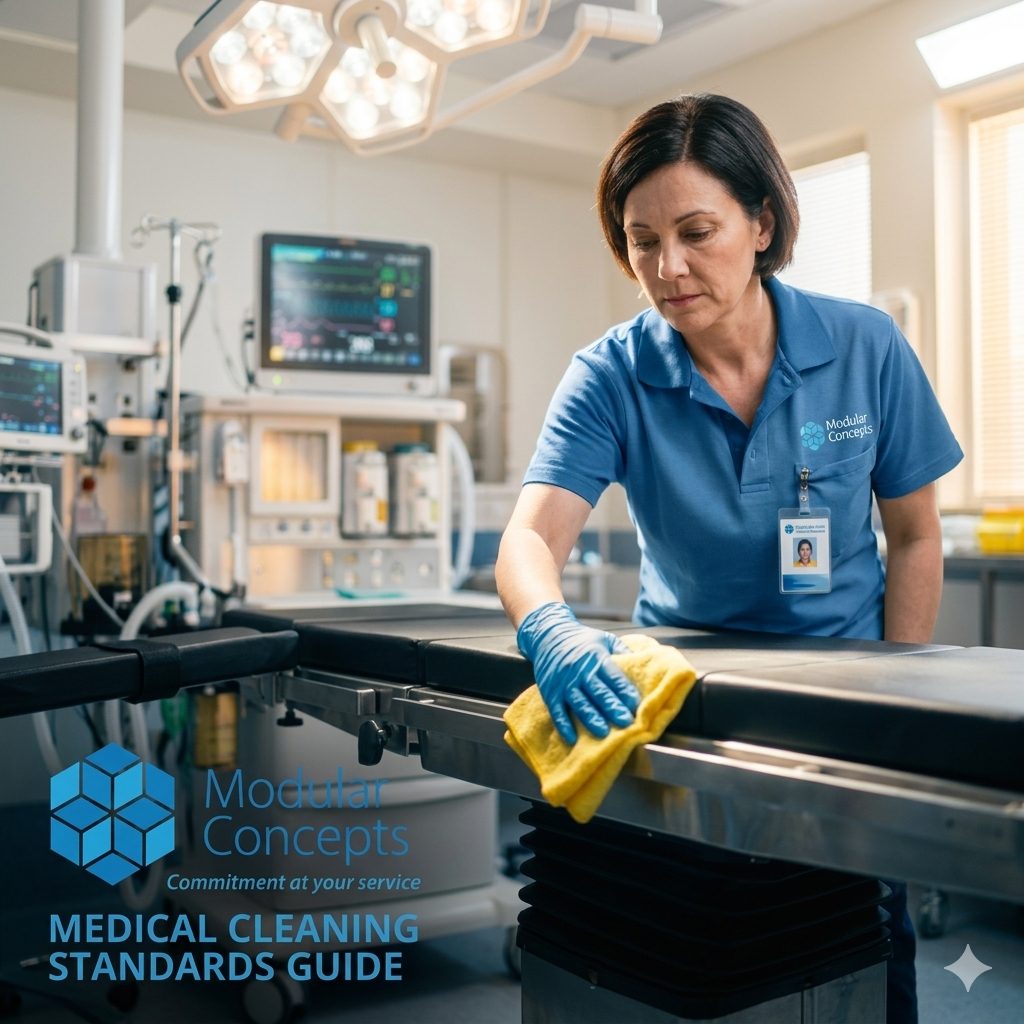
In a medical setting, high-touch surfaces drive most of your cross-contamination risk. Door handles. Light switches. Exam table rails. Pulse oximeters and BP cuffs after each patient. Computer keyboards in shared workstations. Pen cups in waiting areas. Front desk credit card terminals. These are the surfaces that move pathogens between people, and they need attention well beyond what a general office gets.
Contact time, sometimes called dwell time, is where most cleaning programs fall down quietly. Every EPA-registered disinfectant has a label-specified contact time, the number of minutes the surface must remain visibly wet for the kill claim to apply. If the label says four minutes for a particular pathogen and the surface is wiped dry in thirty seconds, you have cleaned the surface but you have not disinfected it. Two different things.
A good medical cleaning program builds the contact time into the workflow. That means using products with realistic contact times for the environment, training crews to apply enough product to keep the surface wet, and not rushing through high-risk areas to hit a time target.
It also means cleaning before disinfecting. Disinfectants do not work well on visibly soiled surfaces. The proper sequence is always clean first to remove organic load, then disinfect with appropriate contact time.
3. Choosing the Right Disinfectants
The product matters. In a medical office, you should expect EPA-registered, hospital-grade disinfectants with documented kill claims for the pathogens relevant to your patient population. For most ambulatory and outpatient settings, that means coverage for common bacteria, mycobacteria where TB exposure is plausible, enveloped and non-enveloped viruses, and norovirus during community outbreaks.
Quaternary ammonium products are common, inexpensive, and effective for most routine surfaces. Hydrogen peroxide-based disinfectants offer faster contact times and broader kill claims with less residue. Bleach-based products remain the gold standard for C. difficile and certain other resilient pathogens, but they damage many surfaces and require careful handling. The right product mix depends on your facility’s surfaces, patient mix, and infection control priorities.
Watch for product substitution. Some cleaning vendors quote a premium disinfectant in the proposal and then quietly substitute a cheaper alternative once the contract is in place. Ask to see the Safety Data Sheets for the products actually being used in your facility. They should match what was specified.
Green cleaning and medical cleaning are not mutually exclusive. EPA-registered disinfectants are now available in formulations with reduced toxicity profiles and Green Seal or EcoLogo certifications. For pediatric, oncology, and behavioral health settings where patient chemical sensitivity is a real concern, low-residue green options are often the better choice provided the kill claims still match the clinical need.
4. Preventing Cross-Contamination
Cross-contamination is when a cleaning process moves contamination from one area to another instead of removing it. In a medical office, this is the single biggest risk factor that separates competent healthcare cleaning from theater.
Color-coded microfiber systems are the standard solution. Different colors of cloths and mop heads are assigned to different risk zones. Red for restrooms and biohazard areas, yellow for clinical exam rooms, blue for general surfaces, green for kitchens and break rooms. Cloths are never reused across zones, never re-dipped into clean solution after touching a contaminated surface, and laundered properly between shifts.
Equipment also moves contamination if it is not managed. Vacuums need HEPA filtration to avoid blowing fine particulate back into clinical air. Buckets need to be emptied and rinsed between rooms. Mop heads need to be changed at the end of each clinical area, not at the end of each night.
Workflow direction matters too. Cleaning moves from clean areas to dirty areas, never the reverse. Top surfaces before low surfaces. Inside the facility before outside entries. These sound like small details until you see what happens when they are skipped for six months in a busy clinic.
5. PPE and Crew Safety
Your cleaning crew is exposed to your facility’s risks every shift. That cuts both ways. They need protection, and your patients and staff need to know that the people walking through the building are trained and equipped.
Standard PPE for medical cleaning includes nitrile gloves, fluid-resistant uniforms or coveralls, closed-toe non-slip footwear, and eye protection when handling chemicals or working in areas with splash risk. N95 or equivalent respirators are required for crews entering airborne isolation rooms or performing certain decontamination tasks. PPE is changed between zones, not just between shifts.
Bloodborne pathogen training is required annually for any crew member who can reasonably expect occupational exposure. Documentation of that training should be on file with the cleaning vendor and available to the practice if requested. The same applies to hazard communication training under OSHA’s HazCom standard, which covers the chemicals the crew handles.
If a sharps injury or blood exposure occurs during a cleaning shift, there should be a documented response protocol. This includes immediate first aid, exposure reporting, source identification where possible, and post-exposure evaluation. Vendors that cannot describe this protocol clearly are not ready for medical work.
6. Daily, Terminal, and Deep Cleaning Explained
Healthcare cleaning programs operate at multiple cadences. Conflating them is one of the most common reasons facilities end up under-cleaned without realizing it.
Daily cleaning is the routine work performed at the end of each clinical day or between shifts. Trash removal, restroom servicing, high-touch surface disinfection, exam room turnover, floor care, and waiting area reset. This is the workhorse layer that keeps the facility presentable and safe.
Terminal cleaning is the more intensive process performed in clinical spaces after specific events. After a known infectious patient, after a procedure that generated splash or aerosol, or as a scheduled monthly or quarterly reset. Terminal cleaning typically involves moving furniture, cleaning behind and under fixed equipment, and using stronger products with longer contact times.
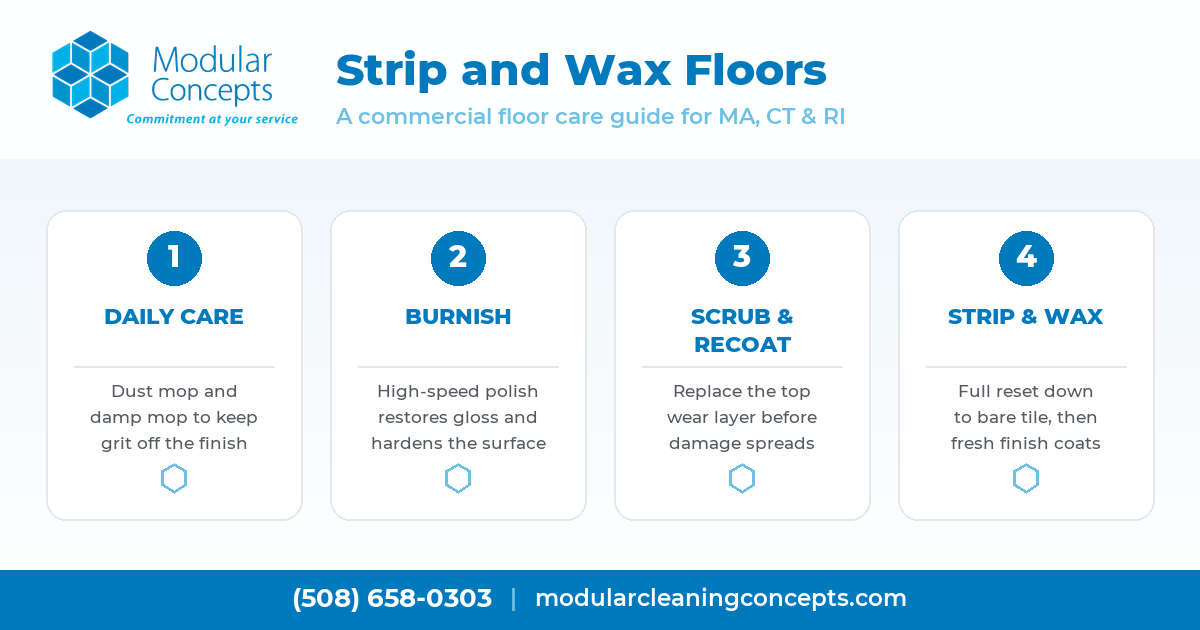
Deep cleaning sits at the facility level. Floor stripping and refinishing, carpet extraction, vent cleaning, light fixture cleaning, baseboards, walls, and other surfaces that are not part of the daily or weekly workflow. Most medical facilities benefit from deep cleaning quarterly at minimum, with high-traffic clinical areas on shorter cycles.
A program that mixes these cadences clearly, schedules them in writing, and documents completion is a program that holds up. A program that runs everything as undifferentiated nightly work is a program that will eventually surprise you.
7. HIPAA, Privacy, and After-Hours Access
HIPAA is not a cleaning regulation, but cleaning vendors who work in medical offices brush up against it constantly. Patient charts on desks. Open EHR sessions on unattended monitors. Conversations overheard during shift overlap with clinical staff. Discarded paperwork in non-shredded waste streams.
Most cleaning vendors are considered Business Associates under HIPAA when they work in covered entities, which means a Business Associate Agreement (BAA) is typically required. The BAA does not turn the cleaning crew into HIPAA experts, but it does establish the legal framework for handling incidental exposure and creates accountability if something goes wrong.
Practical safeguards matter more than the paperwork. Crews should be trained to leave paperwork untouched, lock workstations when they find them open, route any sensitive materials to designated shred bins rather than general trash, and report any unusual situations through a defined channel.
After-hours access is its own consideration. Medical offices typically clean after the practice closes, which means the cleaning crew often has alarm codes, key access, and effectively unsupervised time in the building. Vendor background checks, badged identification, supervisor site visits, and access logs are reasonable expectations. Modular Concepts builds these protocols into every healthcare engagement, with owner-led oversight by Luiz Thomas at client sites.
8. Documentation That Actually Protects You
In a medical setting, documentation is not bureaucracy. It is the evidence that protects your practice when an inspector, an accrediting body, or a plaintiff’s attorney asks how you maintain your environment.
A defensible documentation set includes the cleaning scope of work signed by both parties, the products in use with current Safety Data Sheets, training records for the crew assigned to your facility, daily and terminal cleaning logs with date and crew member identification, inspection records and corrective actions, and any incident reports tied to cleaning activities.
None of this needs to be elaborate. A simple checklist completed nightly and reviewed monthly satisfies the documentation requirement for most ambulatory medical settings. The point is that the records exist, they match what was actually done, and they can be produced on request.
If your current cleaning vendor cannot produce these records within twenty-four hours of being asked, your documentation is functionally absent. That is a risk you should not be carrying.
9. What to Look For in a Healthcare Cleaning Vendor
Vendor selection in healthcare is different from vendor selection in general office cleaning. The bar is higher, the questions are more specific, and the lowest bidder is rarely the right answer.
Ask about training. Specifically, what bloodborne pathogen training the crew has completed in the last twelve months, who delivered it, and where the records live. Ask about products. Specifically, which EPA-registered disinfectants are in current use at your facility and request the Safety Data Sheets. Ask about cross-contamination controls. Specifically, the color-coding system and how cloths and mop heads are managed between zones.
Ask about credentials. BSCAI verification through the Building Service Contractors Association International is a strong baseline signal that a contractor operates to professional industry standards. Ask whether the same crew services your building each shift or whether you get whoever is available. Continuity matters in clinical environments.
Ask about the contract structure. Long-term, locked-in contracts are common in commercial cleaning, but they create misaligned incentives. A vendor that has to earn the renewal each month tends to maintain quality better than one that has guaranteed revenue for two years. Modular Concepts works without long-term contracts for this reason.
Finally, ask who actually visits the site from the vendor’s leadership. If the answer is nobody, the cleaning crew is the entire quality control system. If the answer is the owner, you have a different kind of accountability.
10. The Bottom Line
Medical office cleaning is operationally demanding, regulatorily layered, and consequential when it goes wrong. The good news is that none of it is mysterious. The frameworks exist, the products are available, and the protocols are well established. The work is in execution, training, and documentation, and the difference between a competent vendor and a marginal one shows up clearly when you ask the right questions.
If you operate a medical office, clinic, or healthcare-adjacent facility in Massachusetts, Connecticut, or Rhode Island and you want a cleaning partner who treats your environment with the seriousness it requires, Modular Concepts can help. We are BSCAI verified, our crews are trained for clinical settings, and our owner is on-site at client locations because that is how clinical-grade work gets maintained.
Reach us at (508) 658-0303 for a no-obligation walkthrough and quote. We will tell you honestly what your facility needs, what it should cost, and what a real medical cleaning program looks like.