A practical guide for general contractors, developers & facility managers across Massachusetts, Connecticut & Rhode Island.
Post-construction cleaning is the specialized cleanup that takes a finished build from a dusty job site to a safe, move-in-ready commercial space. It runs in three sequential phases, a rough clean, a detail clean, and a final clean, and uses heavy-duty equipment like HEPA vacuums, floor scrubbers, and pressure washers that routine janitorial work does not. It removes construction dust, protects new finishes, and prepares a building for inspection and occupancy.
A commercial build is not finished when the last trade packs up. It is finished when the space is clean enough to pass inspection, protect its new finishes, and open for business. That final step is post-construction cleaning, and it is a distinct trade with its own equipment, sequence, and safety rules. Treat it as an afterthought and it becomes the thing that delays your certificate of occupancy.
This guide is written for the people who actually own that risk: general contractors coordinating a handoff, developers protecting a finish investment, and facility managers across Massachusetts, Connecticut, and Rhode Island who inherit the building on day one. The goal is to show what professional commercial post-construction cleaning involves, why it is harder than it looks, and how to tell a serious crew from one that will scratch your new glass and spread silica dust through your ductwork.
Here is what to expect: the three-phase process, an area-by-area checklist, the real health hazards hiding in construction dust, how the work protects your finishes and your air, who owns the clean in the construction schedule, and what drives the price.
Table of Contents
- 1. What Post-Construction Cleaning Actually Is
- 2. The Three Phases: Rough Clean, Detail Clean, and Final Clean
- 3. The Area-by-Area Post-Construction Cleaning Checklist
- 4. Silica and Dust: The Hazards Behind the Cleanup
- 5. Indoor Air Quality and the HVAC System
- 6. Protecting New Finishes From Damage
- 7. The Construction Handoff: Who Owns the Clean
- 8. Why Professionals Beat Letting the Crew Sweep Up
- 9. What Drives the Cost of Commercial Post-Construction Cleaning
- 10. The Bottom Line
- Frequently Asked Questions
1. What Post-Construction Cleaning Actually Is
Post-construction cleaning is a separate trade, not a heavier version of nightly janitorial work. The difference is the equipment and the hazard. A standard cleaning crew brings a vacuum and a mop bucket. A post-construction crew brings floor scrubbers, buffers, sweepers, HEPA-filtered and high-powered vacuums, steam cleaners, and pressure washers, because the soil left behind by a build is not everyday soil.
Construction generates fine dust at a scale routine cleaning never encounters. Drywall dust, sawdust, and insulation particles settle into the places nobody thinks to wipe: HVAC vents, the tops of door frames, baseboards, ledges, and corners. Left in place, that construction dust lowers indoor air quality and resettles onto every surface the moment the air handler turns on. Removing it takes industrial-grade equipment and a method, not effort alone.
The reader this matters most to is commercial. New offices, medical and life-science suites, education buildings, warehouses, and co-working spaces across Massachusetts, Connecticut, and Rhode Island all reach the same point near the end of a project where the build is done but the space is not usable. Post-construction cleaning is what closes that gap, and getting it right is the difference between a clean handoff and a punch list that reopens.
2. The Three Phases: Rough Clean, Detail Clean, and Final Clean
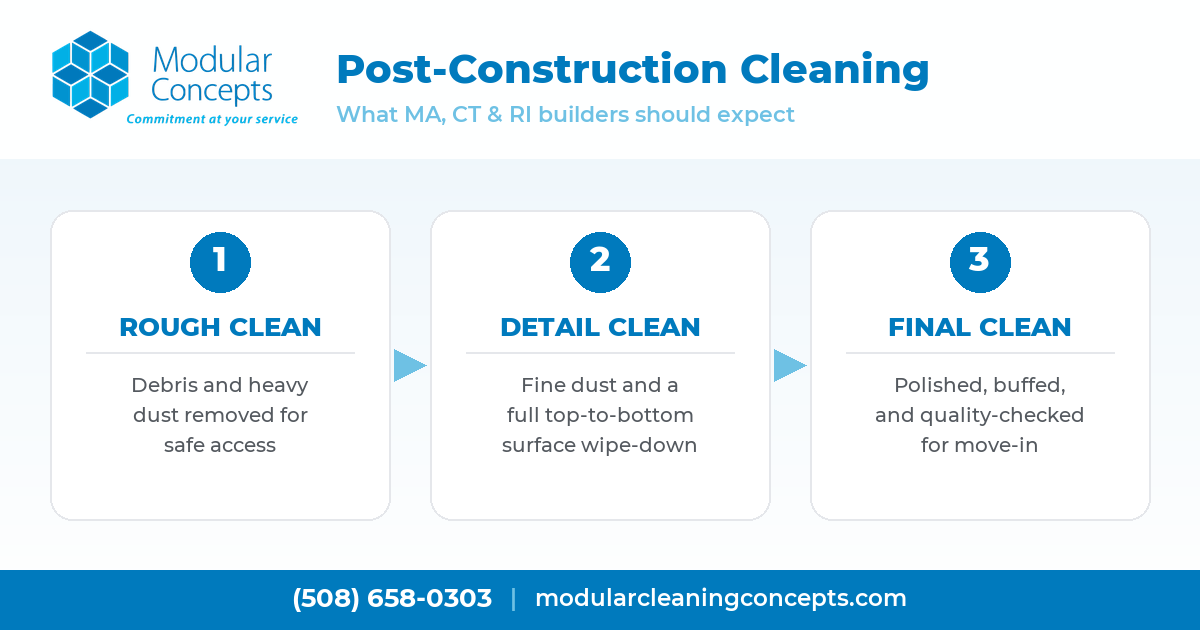
Professional post-construction cleaning is performed in three sequential phases, and the sequence is the point. Each phase has a job, a place in the construction schedule, and a reason it cannot be skipped or combined.
The rough clean is the first and most physically demanding pass. It removes large debris such as wood scraps, drywall pieces, nails, packaging, and plastic coverings, and it clears walkways, entrances, and service paths so the remaining trades can work safely. It happens after major construction is complete enough for safe access but before final finishes like flooring and fixtures go in, and it is coordinated around active punch-list work and subcontractor return visits.
| Phase | When in the schedule | What it accomplishes |
|---|---|---|
| 1. Rough clean | After structural work, before final finishes | Remove large debris and heavy dust for safe access |
| 2. Detail clean | After trim and fixtures are installed | Fine dust removal and a full top-to-bottom wipe-down |
| 3. Final clean | Right before inspection and move-in | Polish, buff, and quality-check for the handoff |
The detail clean is the most labor-intensive phase despite the gentle name. Crews HEPA-vacuum fine dust and wipe down every surface, walls, windowsills, cabinets, baseboards, doors, frames, handles, ledges, and shelves, and they detail restrooms and break rooms. It follows trim and finish installation, and a good crew leaves at least a day after the rough clean so airborne dust can settle first, then works top to bottom so dust falling from high surfaces is captured in the final floor pass. The final clean is a presentation pass, often several days later and roughly a week after construction ends, that re-cleans everything, buffs floors, polishes glass and fixtures, and ends with a quality-control check against a checklist. Skipping or combining phases risks failed inspections, project delays, and damaged surfaces.
3. The Area-by-Area Post-Construction Cleaning Checklist
A real post-construction cleaning checklist is organized by area, because each surface carries its own method. Fine dust has to come off every horizontal and vertical surface, including walls, trim, baseboards, door frames, ledges, light fixtures, vents, and switch plates. Glass gets washed inside and out wherever it can be reached safely, and sills, frames, and tracks get dusted and wiped. Restrooms are sanitized down to the grout lines, and kitchens and break rooms have countertops, backsplashes, appliances inside and out, sinks, and cabinets cleared of dust.
Technique separates a clean from a smear. Crews dust with damp or pre-treated microfiber, never dry cloths, because dry dusting just throws fine particles back into the air to resettle elsewhere. Vacuums run HEPA filters to actually capture construction dust instead of exhausting it. And the residue that a build leaves behind, stickers, protective film, tape, adhesive, paint overspray, caulk, and grout haze, has to be removed from floors, finishes, and glass without scratching them.
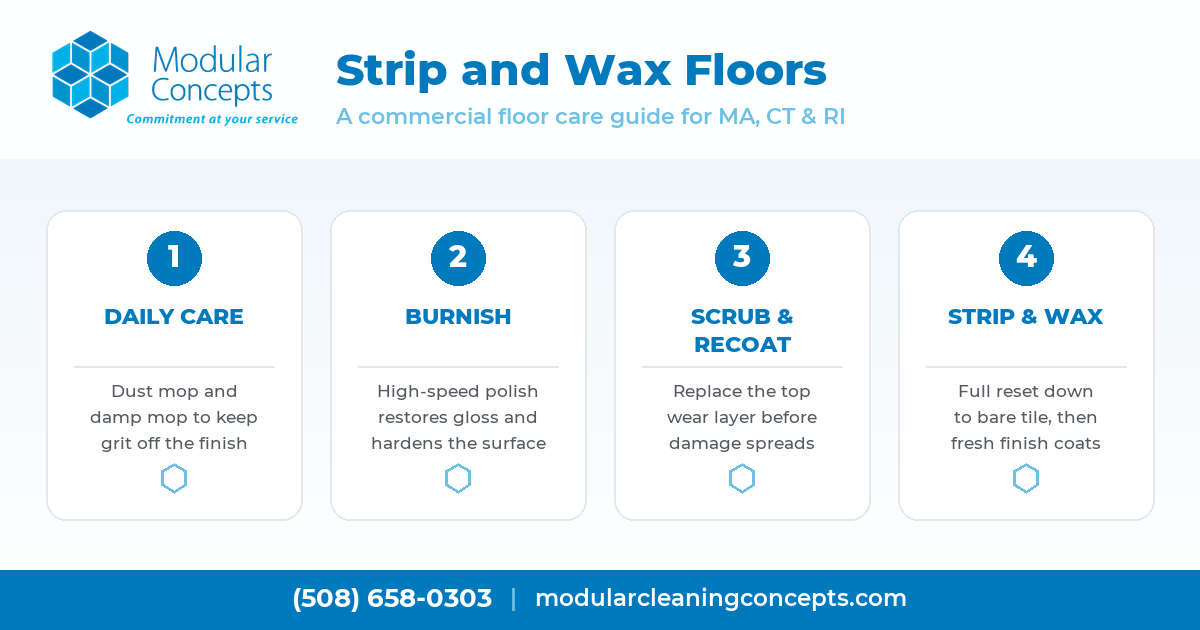
Floors are handled by surface type, and this is where untrained crews do damage. VCT and vinyl are dust mopped and damp mopped with a mild cleaner, then scrub-and-recoat or strip-and-recoat work restores and seals the finish. Sealed concrete is maintained with pH-neutral cleaners and burnishing, not a strip-and-wax process. Carpet is deep-cleaned with commercial hot-water extraction to pull embedded soil that vacuuming cannot reach. All debris and trash is collected and hauled as part of the scope.
4. Silica and Dust: The Hazards Behind the Cleanup
The most important fact about construction dust is that some of it is a regulated health hazard. Dust from concrete, masonry, stone, tile, and grout can contain respirable crystalline silica, and disturbing it by cutting, grinding, or dry sweeping is the single biggest safety issue in post-construction cleanup. This is exactly the part most cleaning blogs skip, and it is the part a facility manager should ask about first.
OSHA regulates it directly. The Respirable Crystalline Silica standard for construction, 29 CFR 1926.1153, sets a permissible exposure limit of 50 micrograms per cubic meter of air as an 8-hour time-weighted average, with an action level of 25 micrograms per cubic meter. The reason for the limit is serious: silica exposure causes silicosis, an incurable and sometimes fatal lung disease, along with lung cancer, chronic obstructive pulmonary disease, and kidney disease. OSHA estimates about 2 million construction workers are exposed across more than 600,000 workplaces.
That is why professional crews do not dry sweep. OSHA prohibits dry sweeping and compressed air for silica-containing dust where safer wet methods or HEPA-filtered vacuuming are available, so trained crews wet down dust, vacuum it with sealed HEPA equipment, and wear respiratory protection. Drywall joint-compound dust adds its own irritants, and wood dust is classified by the National Toxicology Program as a known human carcinogen tied to nasal and sinus cancers. Modular Concepts trains its crews in safe dust-control practice and runs the work with background-checked, insured teams, because this hazard is managed by method, not by hoping the dust stays down.
5. Indoor Air Quality and the HVAC System
A building can look clean and still have dirty air. New construction off-gases volatile organic compounds from paints, solvents, adhesives, glues, building materials, and furnishings, and the EPA notes that indoor VOC concentrations commonly run 2 to 5 times higher than outdoor levels. VOC exposure can cause eye, nose, and throat irritation, headaches, and nausea, and some VOCs are known or suspected carcinogens. Formaldehyde off-gasses from composite wood products like plywood, particleboard, and medium-density fiberboard on top of that.
The HVAC system is where construction dust hides and then redistributes. During a build, fine particles load into ductwork, return grilles, and exhaust vents, so a proper post-construction clean addresses the air path, not just the surfaces. Crews clean grilles and vents inside and out, HEPA-vacuum the openings, and change or clean the HVAC filters a final time to capture the dust trapped during the last stages of work. This protects the system and the people who will breathe through it.
This is a facility-manager and healthcare-or-lab concern more than a cosmetic one, and the industry treats it that way. SMACNA publishes duct-cleanliness guidelines for new construction, and the LEED Construction Indoor Air Quality Management Plan credit requires meeting or exceeding SMACNA’s guidance, including sealing duct openings during construction. Citing those standards is not a claim that any one vendor holds them. It is the bar the work should be measured against before a space is occupied.
6. Protecting New Finishes From Damage
Everything in a finished build is new, which means everything is easy to ruin. The wrong product or method on a fresh surface can scratch it, haze it, or void a manufacturer warranty, and that damage usually shows up after the crew is gone. Protecting the owner’s finish investment is half the job, and it is where method discipline earns its keep.
The chemistry is specific by surface. Sealed concrete needs pH-neutral cleaners, roughly 6.5 to 7.5, because alkaline cleaners above pH 8 can react with the surface and cause irreversible hazing. VCT finish can be destroyed if strippers go down at full concentration without proper dwell time, which eats through the seal coat and softens the tile. Carpet extraction has to control moisture, because overwetting delaminates the latex backing from the fiber face. New glass needs labels, film, and adhesive removed carefully so the blade or solvent never scratches it.
Even dusting follows a rule here: damp or pre-treated microfiber instead of dry cloths, so grit is lifted rather than dragged across a new surface. None of this is guesswork for a trained crew. It is matching the method to the material, every time, which is exactly what owner-involved quality control is meant to catch before a problem becomes permanent. It is also why floor care stays inside its lane, hard-surface care and carpet extraction, rather than promising finishes the trade does not deliver.
7. The Construction Handoff: Who Owns the Clean
On most new commercial builds, the general contractor holds the post-construction cleaning contract as a subcontract line item that bridges substantial completion and move-in day. The defining pressure is that the handover date does not move. Every trade is competing for the same shrinking window at the end of a project, so the GC needs a cleaning crew that can scale up and hit a fixed date rather than one that needs the schedule to be generous.
The deadline ties directly to the certificate of occupancy. A certificate of occupancy is a legal document issued by the local building authority after inspections for fire, electrical, plumbing, HVAC, and mechanical systems, certifying that a building is safe and code-compliant. Most jurisdictions require one before a space can be sold, rented, or opened for business, and operating without one exposes the owner to fines and liability. Cleaning does not appear as its own line in the building code, but inspectors do require safe, sanitary, and code-compliant conditions, so all cleaning phases and any compliance documentation should be complete by the time the space is inspected and walked through.
Tenant fit-outs and build-outs follow the same logic. Customizing a shell or white-box space adds walls, finishes, HVAC, plumbing, and electrical, and close-out includes a punch-list walkthrough, final inspections, and a thorough clean before move-in. Specialist crews support that handoff with documentation, photographic proof of completed tasks, waste-disposal records, and a completed checklist, which is exactly what a GC or owner wants in hand at the final walkthrough.
8. Why Professionals Beat Letting the Crew Sweep Up
The honest case for the alternative is that a construction crew is already on site, so asking them to clean looks cheaper. The reality is that general contractors typically only broom-sweep. They are not scoped or equipped for the deep, detailed cleaning that makes a space move-in ready, safe, and presentable, and the gap shows up at inspection and at the first client walkthrough.
The equipment difference is measurable. A true HEPA filter captures at least 99.97 percent of particles at 0.3 microns, the size that penetrates most easily, which is how fine construction dust actually gets removed instead of recirculated. A standard vacuum without sealed HEPA filtration exhausts those particles right back into the air the crew is trying to clean. Liability is the other half. Many owners and developers will not allow cleaners on site without proof of insurance, so that any damage to new flooring, glass, or fixtures, or any worker injury, does not land on the owner.
Put together, the case for a specialist crew is scale, safety, finish protection, and a deadline that holds. This is the work Modular Concepts is built for: background-checked and insured crews carrying $2,000,000 in general liability coverage, trained in safe dust control, working without a long-term contract, with the owner involved in quality control. That combination is what lets a general contractor hand off a clean building on the date that cannot move.
9. What Drives the Cost of Commercial Post-Construction Cleaning
The price of post-construction cleaning is driven by the building, not a flat rate, so the useful question is what moves it. The biggest factors are square footage of the serviceable area, since most quotes exclude mechanical rooms and unfinished space, the volume of debris and the level of dust, how many of the three phases you need, the number and size of windows, the floor types and number of surfaces, ceiling height and access difficulty, the facility type and detail level, and whether the timeline is a rush.
Those factors swing the total enough that an honest figure only comes from seeing the space. A single-phase touch-up and a full three-phase clean on a large new build are very different jobs, and glass count, floor type, and a tight deadline move the number further. A provider who quotes a flat rate before walking the site is guessing, and that guess usually gets corrected later.
So the only accurate price is a scoped one. The right move is a walkthrough where a provider sees the actual square footage, debris, surfaces, and deadline, then puts a real number on it. Modular Concepts does that walkthrough and quote at no cost across Massachusetts, Connecticut, and Rhode Island, with no obligation.
10. The Bottom Line
Post-construction cleaning is the step that turns a finished build into a usable one. It runs in three phases, removes construction dust and the silica hazard hiding in it, protects new finishes, clears the air and the HVAC system, and gets a building ready for its certificate of occupancy. Done by a crew that only sweeps, it fails inspections and damages finishes. Done right, it disappears, which is the whole point.
If you are a general contractor, developer, or facility manager with a commercial build in Massachusetts, Connecticut, or Rhode Island, Modular Concepts can handle the final clean on the date that cannot move. We are a BSCAI member, we work without a long-term contract, and our owner is involved in quality control because that is how a clean handoff stays clean.
Reach us at (508) 658-0303 for a no-obligation walkthrough and quote. We will tell you honestly what your project needs, what it should cost, and how we would sequence the clean around your handover date.
Frequently Asked Questions
What is post-construction cleaning?
Post-construction cleaning is the specialized cleanup that takes a finished build from a dusty, debris-filled job site to a safe, move-in-ready commercial space. It is performed in three sequential phases, a rough clean, a detail clean, and a final clean, and it uses heavy-duty equipment such as HEPA vacuums, floor scrubbers, and pressure washers that are different from everyday janitorial tools.
What are the three phases of post-construction cleaning?
The rough clean removes large debris and heavy dust to create a safe, workable space, and happens after major construction but before final finishes. The detail clean is the most labor-intensive phase, with fine dust removal and a top-to-bottom wipe-down of every surface after trim and fixtures are installed. The final clean is a presentation pass that re-cleans everything, polishes glass and fixtures, and ends with a quality check right before inspection or move-in.
Why is construction dust a health hazard?
Dust from concrete, masonry, stone, tile, and grout can contain respirable crystalline silica, which OSHA links to silicosis, lung cancer, COPD, and kidney disease. OSHA sets a permissible exposure limit of 50 micrograms per cubic meter and an action level of 25 micrograms per cubic meter over an 8-hour day, and it prohibits dry sweeping or compressed air for silica dust where safer wet or HEPA-filtered methods are available. Drywall and wood dust carry their own respiratory risks, which is why professional crews use wet methods, HEPA vacuums, and respirators.
Who is responsible for cleanup after construction?
On most new commercial builds the general contractor holds the post-construction cleaning contract as a subcontract line item that bridges substantial completion and move-in day. General contractors usually outsource the detailed final clean to a specialist crew because their construction crews typically only broom-sweep and because the handover date does not move.
What affects the cost of post-construction cleaning?
The price is driven by the building, not a flat rate. The main factors are the serviceable square footage, the volume of debris and dust, how many of the three cleaning phases you need, the number and size of windows, the floor types and number of surfaces, ceiling height and access, the facility type, and how tight the deadline is. Because those variables swing the total so much, the most accurate way to get a number is a free, no-obligation walkthrough of the actual space.
Is post-construction cleaning required before a building can open?
A certificate of occupancy is a legal document from the local building authority that certifies a building is safe and code-compliant, and most jurisdictions require one before a space can be sold, rented, or opened for business. Inspectors look for safe, sanitary, and code-compliant conditions, so cleaning and compliance documentation should be complete by the time the space is inspected and walked through.