A practical guide to how your cleaning program affects the air your team breathes, for facilities across Massachusetts, Connecticut & Rhode Island.
Commercial cleaning directly affects indoor air quality. Products that contain volatile organic compounds (VOCs) leave chemical residues that can persist in the air for hours after the crew leaves. Microfiber mop and cloth systems capture fine particles rather than redistributing them into the air column, while standard cotton systems do the opposite. Timing, product selection, and coordination with your building’s ventilation schedule together determine whether your cleaning program supports or works against your facility’s air quality.
Office managers in Massachusetts, Connecticut, and Rhode Island invest real money in HVAC maintenance, air filtration upgrades, and building health certifications. The cleaning program running through those same buildings three or five nights a week rarely gets the same scrutiny. That oversight is where a substantial share of indoor air quality problems originates.
Since 2020, facility managers have paid closer attention to building health. The focus started with surface contamination and has expanded to air quality as the research connecting chemical cleaning products to respiratory irritation has grown more specific and harder to ignore. The 2026 commercial cleaning market reflects this: sustainable cleaning product sales now represent more than half the market by volume, and mid-market facility managers are beginning to ask their cleaning vendors detailed questions about product composition and application methods.
This post explains what is actually happening when your cleaning crew works overnight, what the evidence says about the air quality effects, and what to expect from a contractor who takes building health seriously.
Table of Contents
- Why Your Cleaning Program Is an Air Quality Variable
- What VOCs Are and How Cleaning Products Release Them
- The Microfiber Difference: Capturing Particles vs. Redistributing Them
- Ventilation Timing and Why It Changes the Outcome
- What Green Seal Certification Actually Means for Your Building
- The Honest Case for Conventional Cleaning Products
- Red Flags That Your Contractor Has Not Thought About Air Quality
- Questions to Ask Before You Sign Anything
- How Modular Concepts Handles Building Health
- The Bottom Line
1. Why Your Cleaning Program Is an Air Quality Variable
The single most underexamined variable in commercial building air quality is the cleaning program. Facility managers in Massachusetts, Connecticut, and Rhode Island routinely schedule HVAC filter replacements, test for mold, and commission air quality assessments. The cleaning contractor servicing the same building three or five nights a week often gets no scrutiny at all. That gap is where a significant portion of indoor air quality problems are created, maintained, and blamed on everything but the actual source.
The connection between cleaning and air quality is not speculative. Products applied to surfaces release compounds into the building’s air supply. Those compounds interact with existing indoor chemistry, sometimes producing secondary pollutants that were not present in the original product. In buildings with moderate ventilation, residual compound concentrations can still be measurable the following morning, eight or more hours after the cleaning crew left. The HVAC industry has understood this dynamic for years. The commercial cleaning industry has been slower to engage with it.
Most cleaning programs can improve their air quality footprint without replacing vendors, restructuring budgets, or accepting lower cleanliness standards. Doing so requires a contractor who has thought about the issue systematically and built a program around it. Most contractors have not. The questions later in this post will help you identify the ones who have.
2. What VOCs Are and How Cleaning Products Release Them
Volatile organic compounds are carbon-based chemicals that evaporate into the air at room temperature. In commercial cleaning, VOCs are released by spray disinfectants, floor finish products, carpet cleaners, and solvent-based degreasers. Common examples include formaldehyde, benzene, and limonene, which is the citrus-scented compound found in many all-purpose cleaners. The EPA Safer Choice program evaluates cleaning products for VOC content as part of its ingredient safety review. Green Seal GS-42, which governs cleaning services rather than just products, sets specific VOC thresholds for approved formulations.
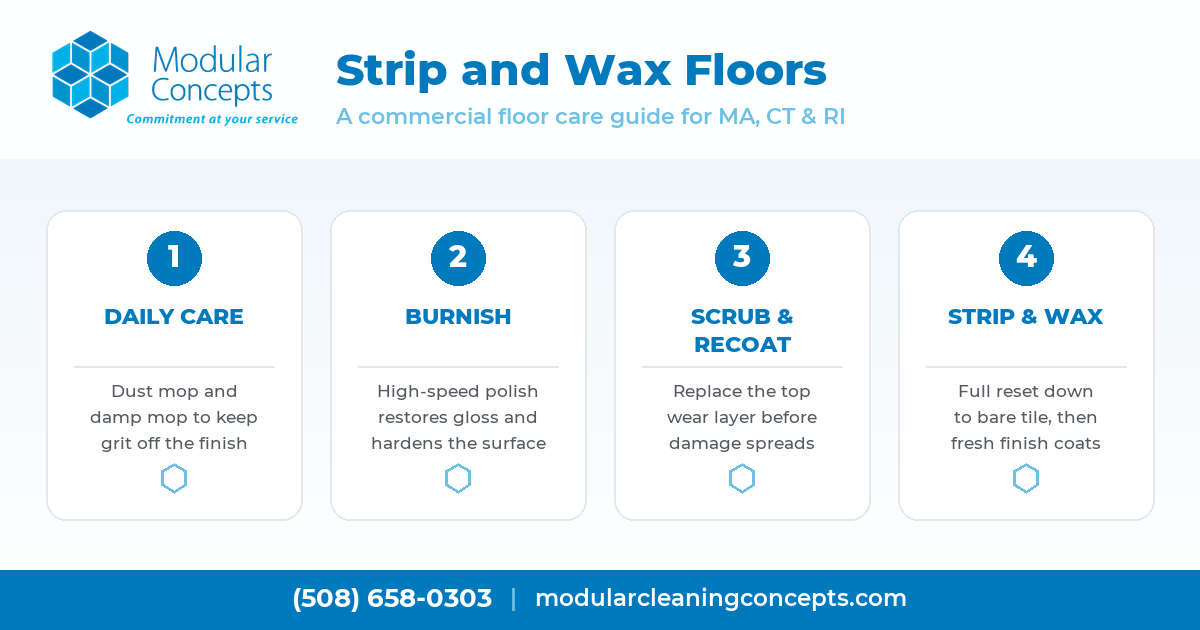
Floor finishing products carry among the highest VOC loads in any cleaning scope. A single strip-and-wax application can release compound concentrations that take 12 to 24 hours to off-gas, depending on the building’s ventilation rate. Spray disinfectants applied at high frequency in tight, poorly ventilated areas contribute to a daily baseline. Neither category is inherently problematic if the products used are low-VOC formulations and the ventilation is managed correctly. Both become air quality problems when neither condition is met, which describes a significant portion of commercial cleaning programs.
The starting point for any facility manager is knowing exactly what products your contractor applies in your building. Not a general category. Not a brand promise about being eco-friendly. The actual product names, dilution ratios, and whether those products appear on the EPA Safer Choice list or the Green Seal approved products database. A contractor who cannot answer that question specifically does not have a managed product program.
3. The Microfiber Difference: Capturing Particles vs. Redistributing Them
Dust in a commercial office is not just dirt. The fine particulate matter in any occupied building includes skin cells, paper fibers, pollen, mold spores, and trace accumulations of every chemical compound applied to the building over months and years. That particulate matters for air quality because it carries both biological and chemical content, and because it becomes airborne during the cleaning process whether or not that is the intended outcome.
Standard cotton mops and loop-style cleaning cloths move particulate matter around a surface. Some of it is captured. A larger portion is redistributed into the air column where it temporarily becomes part of what occupants breathe, and where it settles on newly cleaned surfaces within the hour. Microfiber technology works differently. The fiber structure creates a surface-area-to-volume ratio that mechanically captures particles rather than displacing them. Studies comparing microfiber to conventional cotton systems have consistently found lower post-cleaning airborne particle counts when microfiber is used with proper technique and maintained through correct laundering protocols.
If your cleaning crew is working your open-plan hard floor areas with cotton mops, the floor may look clean while the air immediately above it is carrying more fine particulate than it did before the cleaning started. Microfiber also requires less cleaning product per square foot to achieve equivalent surface cleanliness, which compounds the air quality benefit by reducing the VOC load at the same time.
4. Ventilation Timing and Why It Changes the Outcome
This is the part most cleaning discussions skip. You can use the lowest-VOC products available, run a fully certified Green Seal program, and equip the crew with microfiber throughout, and still create an air quality problem if the building’s ventilation is not managed correctly during and after cleaning. The mechanism is straightforward: cleaning compounds are released into the air while the building’s HVAC system is in its overnight setback mode.
Modern commercial buildings are designed for energy efficiency. High-performance windows, good insulation, and reduced overnight HVAC airflow are features that building owners and tenants pay for. At reduced airflow, chemical compounds that would dilute within an hour under full HVAC operation can accumulate and persist until the system ramps back up in the morning. The timing of high-product-use cleaning tasks, particularly floor finishing and deep disinfection work, relative to when the HVAC enters setback mode is a variable that most cleaning contractors have never been asked to manage.
The solution is coordination. The cleaning contractor should know when the building’s air handling units enter setback mode and should either complete VOC-heavy tasks before that point or submit a request for extended ventilation run-time on cleaning nights. This requires the contractor to understand the building systems well enough to have the conversation. A vendor who manages their own schedule in isolation is not managing your building. A partner does both.
5. What Green Seal Certification Actually Means for Your Building
Green Seal is an independent nonprofit certification organization. Its GS-42 standard applies specifically to commercial cleaning services, not just cleaning products. The distinction is important. A contractor can purchase Green Seal-certified products and apply them using practices that defeat the environmental and health benefits entirely. GS-42 requires trained crews, approved product lists, documented green cleaning plans, and periodic updates to keep pace with product reformulations and evolving certification requirements.
For a facility manager evaluating two contractors who both describe their service as green cleaning, the presence of Green Seal training against the GS-42 standard is a meaningful differentiator. It means the crew was trained against a published, auditable standard rather than given different bottles and told to proceed. The air quality benefit of a Green Seal-compliant program compounds over time: reduced VOC products combined with microfiber technique and documented protocols that do not degrade month over month produce better long-term results than any individual component produces in isolation.
For facilities in Massachusetts, Connecticut, and Rhode Island that maintain LEED operational certifications, pursue internal sustainability reporting, or work with property management companies that set environmental standards, a documented Green Seal cleaning program is a reportable contribution. Ask your contractor whether their program meets GS-42, and ask them to provide the documentation. A claim without documentation is not a certification.
6. The Honest Case for Conventional Cleaning Products
Green cleaning is not always the right answer, and a contractor who presents it as a universal solution is not giving you honest guidance. Conventional cleaning products, including EPA-registered disinfectants and quaternary ammonium compounds, exist because they perform at levels that some green alternatives do not match in high-risk environments. In healthcare-adjacent settings, daycares, or any facility managing active infection control programs, the pathogen reduction performance of conventional disinfectants is not a tradeoff worth making.
The real-world tradeoff is that conventional disinfectants carry higher VOC loads, require more careful ventilation management, and leave more chemical residue on surfaces after application. For a standard commercial office where the occupants are healthy adults and the contamination risk is low, this tradeoff frequently favors a lower-VOC alternative. For a medical office or a school health room, the tradeoff may go the other way. A cleaning program that does not differentiate by zone is not accounting for the actual risk profile of your facility.
The right answer in most commercial buildings in Massachusetts, Connecticut, and Rhode Island is a documented hybrid: Green Seal-compliant products in open office areas, breakrooms, and low-risk corridors, with conventional EPA-registered products in restrooms, clinical spaces, and any area with a documented contamination protocol. A contractor who applies the same product everywhere is managing their own operational simplicity, not your building’s health.
7. Red Flags That Your Contractor Has Not Thought About Air Quality
Several observable patterns indicate a cleaning program that is working against your building’s air quality rather than supporting it. These are visible during a walk-through or a direct conversation with your current contractor, before you sign anything or make a change.
Heavy fragrance when you arrive in the morning is a signal, not a quality indicator. Strong floral or citrus scent often means the products used contain high-VOC fragrance compounds. A clean building managed with low-VOC products smells neutral, not perfumed. Open chemical containers on cleaning carts or in supply closets are actively off-gassing into the building. Containers should be sealed when not in use, and dilution stations should be ventilated. Cotton mops still in use on open-plan hard floors indicate a program that has not been updated in years. And if the contractor applies the same product in the break room and the medical suite without differentiation, they are managing their own operational simplicity, not your facility’s actual risk profile.
No conversation about HVAC coordination is perhaps the clearest diagnostic. Ask any contractor you are evaluating whether they know when your building’s air handling units enter setback mode and how they manage that relative to their cleaning schedule. A contractor who has never considered the question is not building a program that accounts for your building’s actual ventilation dynamics. For facilities across Massachusetts, Connecticut, and Rhode Island, these flags are visible and verifiable before you commit to a vendor relationship.
8. Questions to Ask Before You Sign Anything
The evaluation conversation is where you learn what a contractor actually knows. These questions take about ten minutes to work through, and the quality of the answers reveals more than the price quote.
What specific products does your crew use in standard office environments, and are any of them on the EPA Safer Choice list or Green Seal approved products database? A contractor who names specific products and can reference a certification program has thought about this. One who describes eco-friendly practices without specifics has not. How do you train your crews on dilution ratios, application technique, and ventilation requirements? Ask to see the written protocol. A contractor who trains for air quality has one. What is your mop system for hard floor surfaces? Ask specifically whether microfiber is standard or an optional upgrade. In a well-run program it is the default.
Do you provide a documented green cleaning plan? Green Seal GS-42 requires one, and a contractor who cannot provide documentation of their cleaning methodology is operating on informal practice. That means quality depends entirely on whoever is assigned to your building on any given night. Ask whether they can provide records of the products in use at your facility, updated when formulations change. Documentation is the difference between a program and a promise, and any contractor who has been operating responsibly already has it ready.
9. How Modular Concepts Handles Building Health
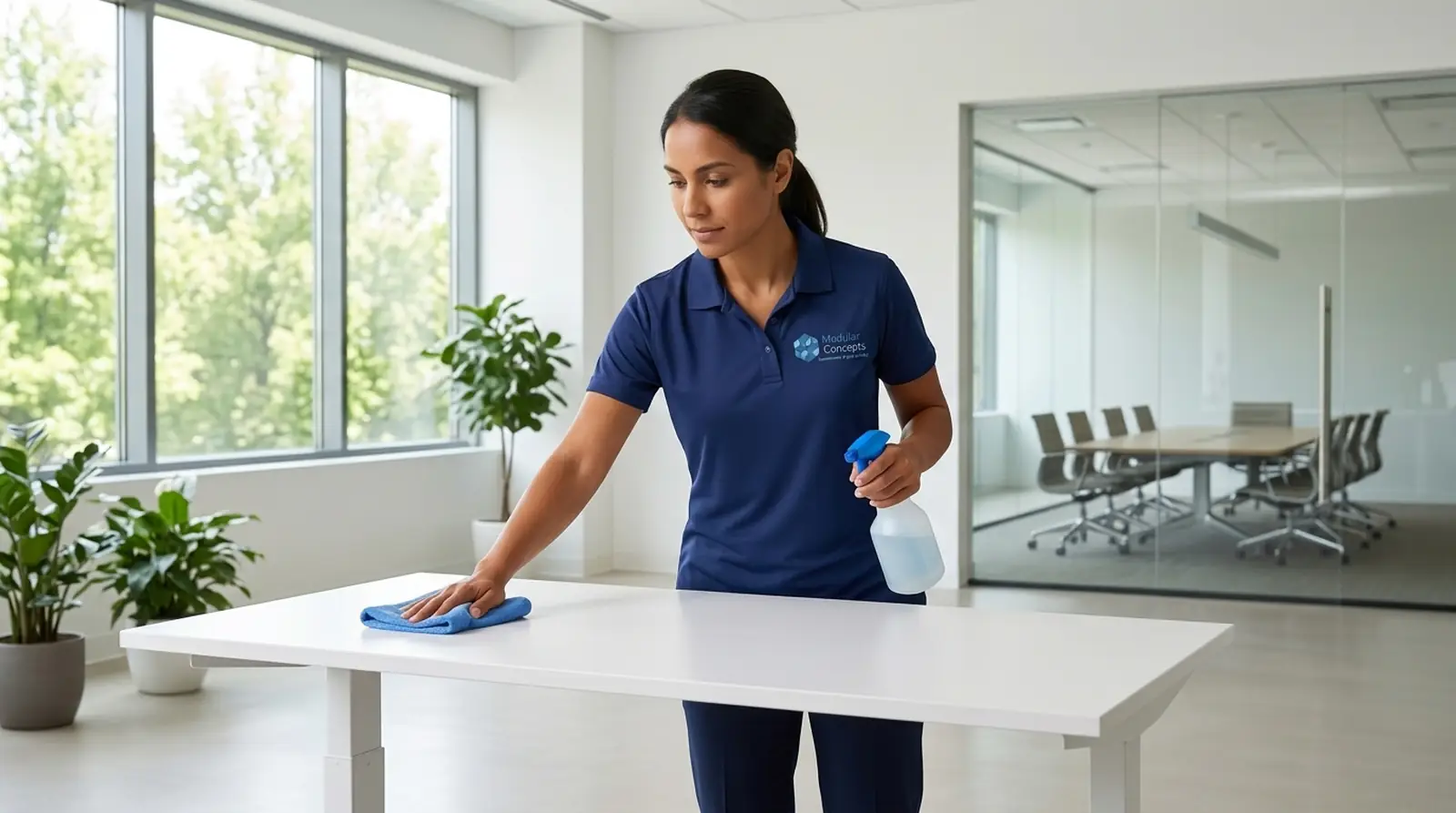
Modular Concepts operates a Green Cleaning program across client facilities in Massachusetts, Connecticut, and Rhode Island. Every crew member is Green Seal trained, which means they work from a documented cleaning protocol rather than a general sense of best practices. The protocol covers product selection by zone, dilution and application methods, microfiber system use and laundering requirements, and ventilation coordination with building management teams.
The operational specifics are worth stating plainly. Microfiber mop and cloth systems are the standard for all hard surface and dusting work. Product selection follows Green Seal GS-42 criteria in standard commercial environments, with conventional EPA-registered products applied in restrooms and any zone where infection control requirements are documented by the client. Dilution ratios are controlled by dispensing systems rather than individual crew judgment, which removes a significant source of product overuse and inconsistent VOC load. High-product-use tasks are scheduled with HVAC setback timing in mind, and clients receive records of the products in use at their facility.
This program runs the way it does because BSCAI verification requires documented practices that can be reviewed, not verbal assurances. Luiz Thomas visits client sites personally as part of quality control, which is how practice-level issues are caught before they become complaints. The no-long-term-contract structure means Modular earns the renewal by delivering results every month, including air quality results that are observable by anyone who walks in the morning after the crew has left.
10. The Bottom Line
Your cleaning program is an active variable in your building’s indoor air quality. Product formulations, application technique, microfiber adoption, and ventilation coordination all influence what your team is breathing the morning after the cleaning crew finishes.
If you operate a commercial facility in Massachusetts, Connecticut, or Rhode Island and want a cleaning partner who approaches building health with the same rigor as surface cleanliness, Modular Concepts can help. We are BSCAI verified, we run a documented Green Seal training program across our full crew, we work without long-term contracts, and our owner visits client sites personally because that is how good work gets done and stays done.
Reach us at (508) 658-0303 for a no-obligation walkthrough and quote. We will tell you honestly what your facility needs, what it should cost, and how we would structure a program that supports your building’s air quality alongside its cleanliness standards.
Frequently Asked Questions
How long do cleaning product VOCs remain in the air after the crew leaves?
Most commercial cleaning VOCs off-gas within two to eight hours under normal building ventilation. Floor finishing products, particularly strip-and-wax applications, can take 12 to 24 hours depending on ventilation rate and product formulation. Buildings in overnight HVAC setback mode will see longer off-gassing times because reduced airflow slows dilution. Scheduling high-VOC tasks before the HVAC enters setback mode, or requesting extended ventilation run-time on cleaning nights, is the most effective way to reduce next-morning residual levels.
What is the difference between a Green Seal cleaning service and one that just uses eco-friendly products?
Green Seal GS-42 is a performance standard for commercial cleaning services that covers crew training, approved product lists, documented cleaning plans, and ongoing compliance requirements. A contractor who uses eco-friendly products without GS-42 training is choosing different chemicals but not necessarily applying them correctly or managing the associated ventilation requirements. The certification applies to the full program, including technique and documentation, not just the product labels on the bottles.
Can my office cleaning program help qualify for LEED building certification?
Yes. LEED for Building Operations and Maintenance includes credits for sustainable cleaning practices under the Indoor Environment Quality category. A documented Green Seal GS-42 cleaning service can contribute to credit achievement. The documentation requirements are the key: your contractor needs to provide records of the program, the products in use, and the training standards applied. A verbal green commitment does not satisfy LEED documentation requirements.
Is microfiber cleaning meaningfully better for air quality, or is it a marketing claim?
The evidence supports microfiber as a real improvement over conventional cotton and loop-mop systems for airborne particle counts. Multiple studies in commercial and healthcare settings have documented lower post-cleaning particulate levels with microfiber compared to conventional systems. The benefit is technique-dependent: microfiber that is overloaded, used dry when it should be damp, or laundered incorrectly loses its mechanical capture advantage. A well-trained crew using microfiber correctly produces measurable air quality improvements. A crew handed microfiber cloths without proper training does not.
How do I know if my current cleaning contractor is using low-VOC products?
Ask them directly to provide the product names used in your facility and confirm whether those products appear on the EPA Safer Choice list or Green Seal approved products database. Both databases are publicly searchable. If your contractor cannot name specific products, or if the products they name do not appear on either list, the program is using conventional formulations regardless of how it is described in their marketing materials. This question takes two minutes and gives you a definitive answer.