A practical guide for facility managers and business owners across Massachusetts, Connecticut, and Rhode Island.
Most commercial cleaning plans fail for the same reason. Someone writes a long checklist, hands it to a vendor, and assumes the building will stay clean. Six months later, the trash is overflowing on Mondays, the carpets look tired, and nobody knows who is responsible for what.
A real cleaning plan is not a checklist. It is a working system that matches your building, your schedule, your budget, and the people who actually do the work. Done right, it lowers your costs, keeps your team healthy, and makes your facility look like somewhere people want to spend their day.
Here is how to build one that holds up, with the steps we use at Modular Concepts when we onboard a new client across MA, CT, and RI.
Table of Contents
- Assess What Your Facility Actually Needs
- Set Goals You Can Actually Measure
- Build a Budget That Reflects Reality
- Create a Schedule That Fits Your Operation
- Choose Supplies That Pull Their Weight
- Train the People Doing the Work
- Monitor and Evaluate Performance
- Build a Real Feedback Loop
- Stay Compliant Without Overcomplicating It
- Keep Stakeholders in the Loop
- The Bottom Line
1. Assess What Your Facility Actually Needs
Every cleaning plan starts with a walkthrough. Not a clipboard tour. A real walkthrough where you look at your building the way a stranger would. Where does foot traffic concentrate? Which surfaces show wear? Where do people eat, gather, or wait?
A 4,000 square foot medical office in Worcester needs a completely different approach than a 25,000 square foot warehouse in Hartford or a co-working space in Providence. The square footage is only part of the story. What matters more is how the space is used, who uses it, and what kind of impression it needs to make.
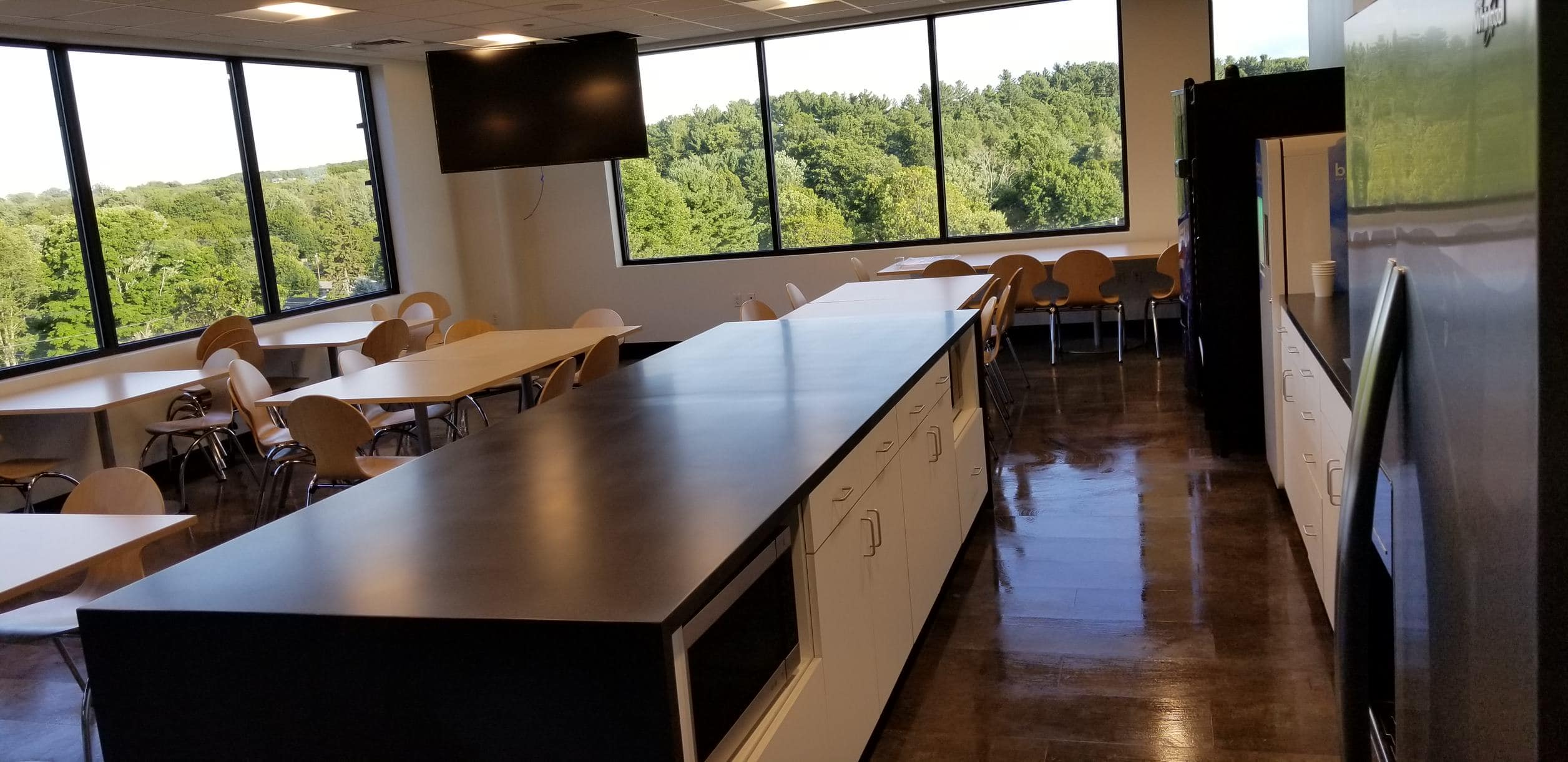
Pay particular attention to high-traffic zones. Lobbies, restrooms, break rooms, and shared corridors carry most of the dirt and most of the germs. These are the areas where cleaning frequency directly affects employee health and visitor perception. If you cut corners anywhere, do not cut them here.
Industry context also drives the plan. Healthcare and life sciences facilities have disinfection standards that office buildings do not. Educational facilities have peak-load schedules tied to the academic calendar. A solid plan is built around these realities, not around a generic template.
2. Set Goals You Can Actually Measure
If your only goal is “keep the place clean,” you have no plan. You have a wish.
Good objectives are specific and observable. Reduce sick days by ten percent. Cut visible carpet wear in high-traffic zones. Pass quarterly health inspections without findings. Hit ninety percent satisfaction on internal surveys. These are measurable. You can tell at the end of a quarter whether you got there.
Pair each goal with a performance standard. A clean restroom at 9 a.m. is not the same as a clean restroom at 4 p.m. Define what acceptable looks like at different times of day, in different parts of the building. Write it down. Share it with your cleaning team. Standards that exist only in someone’s head do not travel.
Once you have goals and standards, build a few simple KPIs around them. Frequency completed versus scheduled. Number of cleanliness complaints per month. Inspection scores. You do not need a dashboard. You need three or four numbers you can look at and know whether the plan is working.
3. Build a Budget That Reflects Reality
Cleaning is one of those line items where the cheapest option almost always costs more in the long run. Underbid contracts get short-staffed. Short-staffed crews skip steps. Skipped steps turn into deep-cleaning emergencies, premature carpet replacement, and angry tenants.
Budget across three categories. Supplies and equipment. Labor (whether in-house or contracted). And a contingency line for the things you cannot predict, like a flu outbreak that requires extra disinfection or a contractor leaving behind a mess after a renovation.
If you are getting bids from outside vendors, do not just compare the bottom-line numbers. Compare what is included. One quote at $1,200 a month with weekly floor care included is usually a better deal than $900 a month with floor care billed separately. Ask what happens when something needs extra attention. Ask whether the same crew shows up each week or whether you are getting whoever was available that day.
At Modular Concepts, we work without long-term contracts because we think the work should earn the renewal each month. That model only works if the budget is set honestly on both sides from the start.
4. Create a Schedule That Fits Your Operation
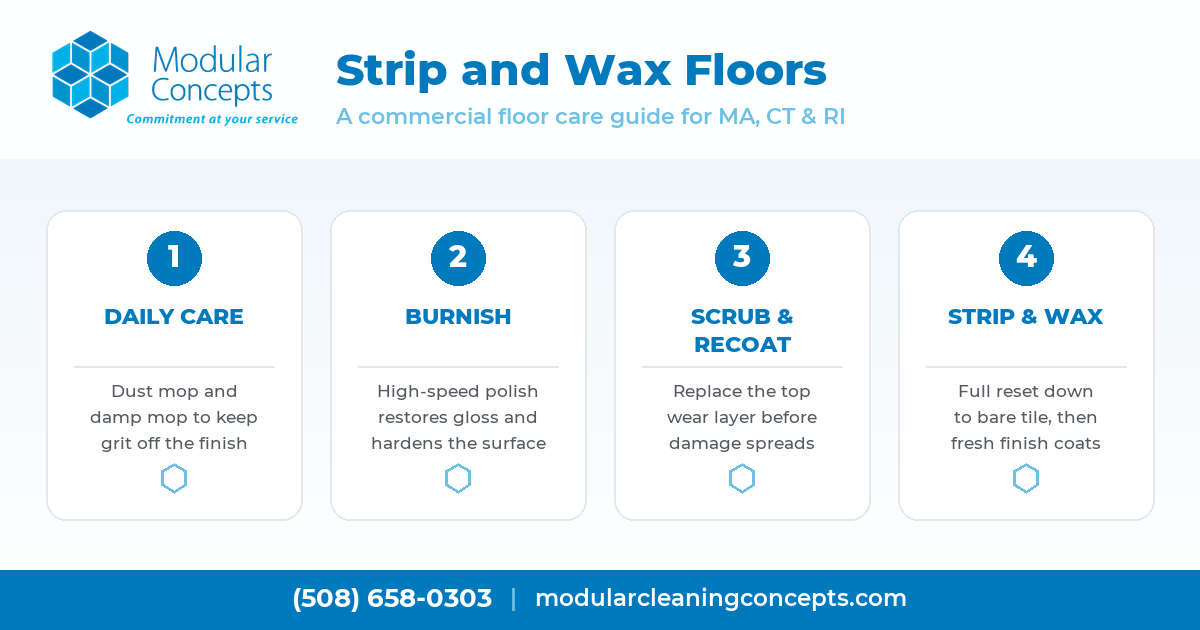
Most facilities need a layered schedule. Daily tasks like trash, restrooms, and high-touch surface disinfection. Weekly tasks like detailed floor care and dusting. Monthly and quarterly tasks like deep carpet cleaning, vent dusting, and grout work.
Build the schedule around when your building is empty, not when your cleaning crew is available. Cleaning during occupied hours frustrates employees and creates safety issues. Cleaning when the building is empty also lets crews work faster and use stronger products without exposure concerns.
Adjust seasonally. Winter in New England means more salt, sand, and slush coming in on shoes, which means floor mats and floor care need more attention from November through March. Summer brings different concerns, including pest pressure and HVAC dust. The schedule should bend with the calendar.
Keep room for one-off events. If you are hosting a board meeting, an open house, or a major client visit, the regular schedule will not cut it. Build that flexibility into the plan upfront so it is not a fire drill every time.
5. Choose Supplies That Pull Their Weight
The supply closet quietly tells you everything about a cleaning operation. If it is full of generic chemicals in unlabeled bottles, the plan is in trouble.
Pick products based on what you actually need to do. Disinfectants need EPA registration and proven kill claims for the pathogens that matter to your facility. Floor finishes need to match your floor type. Glass cleaners and surface cleaners should not leave residue that builds up over time.
Eco-friendly products have come a long way. Modern green chemistry can match conventional cleaners on performance, and for healthcare, education, and life sciences facilities, the lower chemical exposure is often a serious advantage. We use green products by default for clients who want them, and we can match the cleaning standards either way.
Whatever you choose, build a steady supply chain. Running out of liners or paper products on a Friday afternoon is a small problem that becomes a big one fast. Bulk purchasing on consumables and quarterly reviews of usage patterns prevent most of these headaches.
6. Train the People Doing the Work
A cleaning plan is only as good as the crew executing it. Training is where most plans quietly fall apart. New hires learn from whoever is on shift. Bad habits get baked in. Standards drift.
Build a real onboarding program. Cover the products, the equipment, the safety protocols, and the standards specific to your facility. Refresh that training at least annually, more often if you have meaningful turnover or if products and procedures change.
Safety is non-negotiable. Personal protective equipment, chemical handling, ladder safety, and bloodborne pathogen procedures all need formal training. Document it. Sign-offs protect your team and your business if anything ever goes wrong.
Beyond the technical training, build in a culture where the crew can raise issues without friction. The cleaner who notices a leak under the breakroom sink before anyone else is one of the most valuable people in your building. Make sure they have a clear channel to report it.
7. Monitor and Evaluate Performance
If nobody inspects, nothing improves. That is the single most common reason cleaning plans degrade over time.
Set up regular inspections. Monthly walkthroughs by a supervisor, quarterly walkthroughs that include the client or facility owner, and annual reviews of the overall program. Document what you find. Patterns matter more than individual data points, and only documentation surfaces the patterns.
At Modular Concepts, our owner Luiz Thomas personally visits client sites as part of our quality control. That is not a marketing line. It is the only way to know whether the work matches the standard, and it is the difference between a plan that works in theory and one that holds up in practice.
Use technology where it helps. Cleaning management software can track tasks, log completion, and generate inspection reports. None of it replaces a real human walkthrough. It just makes the human walkthrough more efficient.
8. Build a Real Feedback Loop
Your employees and your tenants know things about your building that no inspection will ever catch. The bathroom that always smells funny on Wednesday mornings. The conference room carpet that gets coffee stains nobody addresses. The breakroom trash that fills up by 11 a.m.
Give them a way to say so. A short quarterly survey works for most facilities. A simple suggestion form, digital or physical, works for ongoing feedback. The format matters less than the follow-through. If people give feedback and nothing changes, they stop giving feedback. That is worse than not asking in the first place.
When feedback comes in, close the loop. Tell people what you heard, what you are doing about it, and when. Even when the answer is “we cannot fix that right now,” people respond better to honesty than silence.
Adjust the plan based on what you learn. Cleaning plans are living documents. The version you have at the end of year one should not be the same version you have at the end of year three.
9. Stay Compliant Without Overcomplicating It
Every facility operates under some kind of regulatory framework. OSHA covers the safety side. The Massachusetts Department of Public Health, the Connecticut Department of Public Health, and the Rhode Island Department of Health each have their own guidelines for various facility types. Healthcare adds another layer through Joint Commission and CDC guidance.
You do not need to memorize every regulation. You do need to know which ones apply to your facility and make sure your cleaning plan reflects them. A general office has a lighter load. A medical office or a school carries more obligations.
Documentation is your friend. Keep records of what was cleaned, when, with what product, and by whom. Keep training records. Keep Safety Data Sheets accessible for every chemical on the property. None of this is glamorous, and all of it matters the day an inspector shows up or an incident occurs.
Working with a BSCAI-verified contractor takes a lot of this off your plate. The Building Service Contractors Association International sets professional standards for the cleaning industry, and BSCAI members operate to those standards by default. It is one of the cleanest signals you can use when evaluating a vendor.
10. Keep Stakeholders in the Loop
A cleaning plan that lives in a binder on someone’s shelf is not really a plan. It is a document. The plan only becomes real when the people who depend on it understand it and trust it.
Brief management quarterly. Show them the metrics, the budget actuals against forecast, and the issues that came up. If something needs investment, tell them now, not when it becomes an emergency. Leaders support cleaning programs when they see the numbers and understand the stakes.
Engage employees in the conversation. They do not need every detail. They do need to know what the plan covers, who is responsible for what, and how to flag issues. A short note in an onboarding packet and an annual reminder usually does it.
If you work with an external vendor, treat them like a partner, not a transaction. Regular check-ins, honest feedback, and a clear escalation path produce far better results than the alternative.
The Bottom Line
A commercial cleaning plan is not paperwork. It is an operational system that protects your people, your reputation, and your bottom line. Build it around your actual facility, set goals you can measure, train the crew that does the work, and inspect what matters.
If you operate a commercial facility in Massachusetts, Connecticut, or Rhode Island and you want a cleaning partner who treats your building like their own, Modular Concepts can help. We are BSCAI verified, we work without long-term contracts, and our owner is on-site at client locations regularly because that is how good work gets done.
Reach us at (508) 658-0303 for a no-obligation walkthrough and quote. We will tell you honestly what your facility needs, what it should cost, and how we would build the plan.