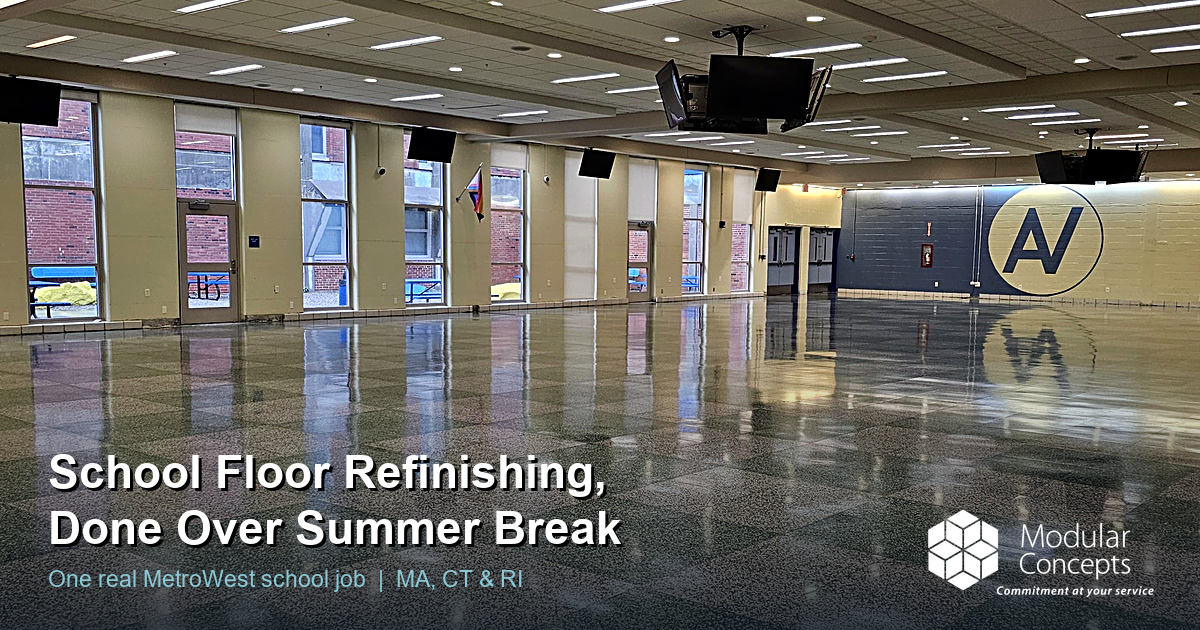
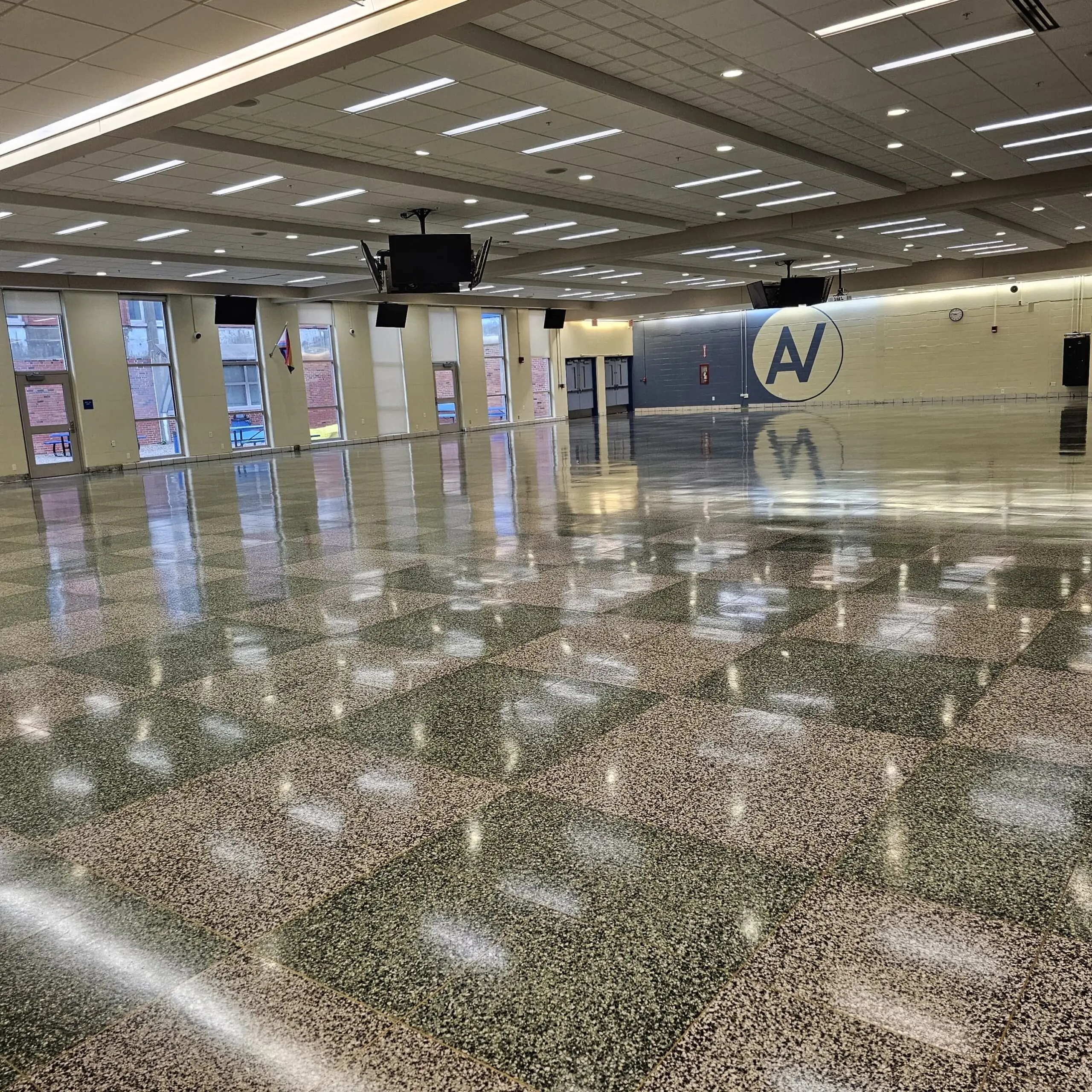
School floor refinishing is the most invisible work in education. It happens when nobody is in the building, it wraps before anyone comes back, and when the crew does it right, the only evidence is a floor that looks brand new on the first day of school. This summer our crews spent part of that window inside a public school campus in MetroWest Massachusetts, refinishing classroom floors, long corridors, a science lab, and a terrazzo cafeteria.
This post is the story of that job, with the real photos to prove it. It is not a technical manual. It is what the work actually looks like, why it all happens in July and August, and why somebody will refuse to walk across a perfectly dry floor in September.
If you manage a school, an office, a clinic, or a warehouse anywhere in Massachusetts, Connecticut, or Rhode Island, the details differ but the calendar logic is identical: floors get one real chance a year to recover. Here is what that chance looks like when it gets used well.
Table of Contents
- 1. The Quietest Building in Town
- 2. What Ten Months of Traffic Does to a Floor
- 3. Strip It Bare, Then Build It Back
- 4. The Hallway Test
- 5. Terrazzo Is a Different Animal
- 6. No, It Is Not Wet
- 7. Why This All Happens in July
- 8. One Campus, Four Kinds of Floors
- 9. The Owner Was on Site
- 10. The Bottom Line
1. The Quietest Building in Town
Massachusetts requires at least 180 school days a year under 603 CMR 27.03. Nobody regulates the other 185 days, and that is when floors get their only honest chance to recover.
For ten months the building belongs to students. Every hallway, classroom, and cafeteria runs at full occupancy on a bell schedule, and no floor crew can compete with that. Then June ends, the buses stop coming, and the same building turns into something rare: thousands of square feet of open floor with no schedule to work around, no furniture to shuffle mid-class, and no foot traffic landing on a finish before it has hardened.
That is the entire secret of the summer window. It is not that the work is different. It is that the building finally cooperates. Our crews look forward to school vacation at least as much as the students do, which says something, because the students seem pretty enthusiastic about it.
What the crews find when they arrive is the subject of the next section, and the before photo tells most of that story on its own.
2. What Ten Months of Traffic Does to a Floor
The before photo below is not neglect. It is arithmetic.
Take one classroom floor. Give it 180 school days of chair legs, backpack drops, sneakers, salt, and grit. The sacrificial finish layer wears through in the traffic lanes first, and once it does, grime starts working into tile that no longer has protection. Daily cleaning keeps a floor sanitary, but wear is not dirt. You cannot mop away a worn finish any more than you can wash a car back into new paint.
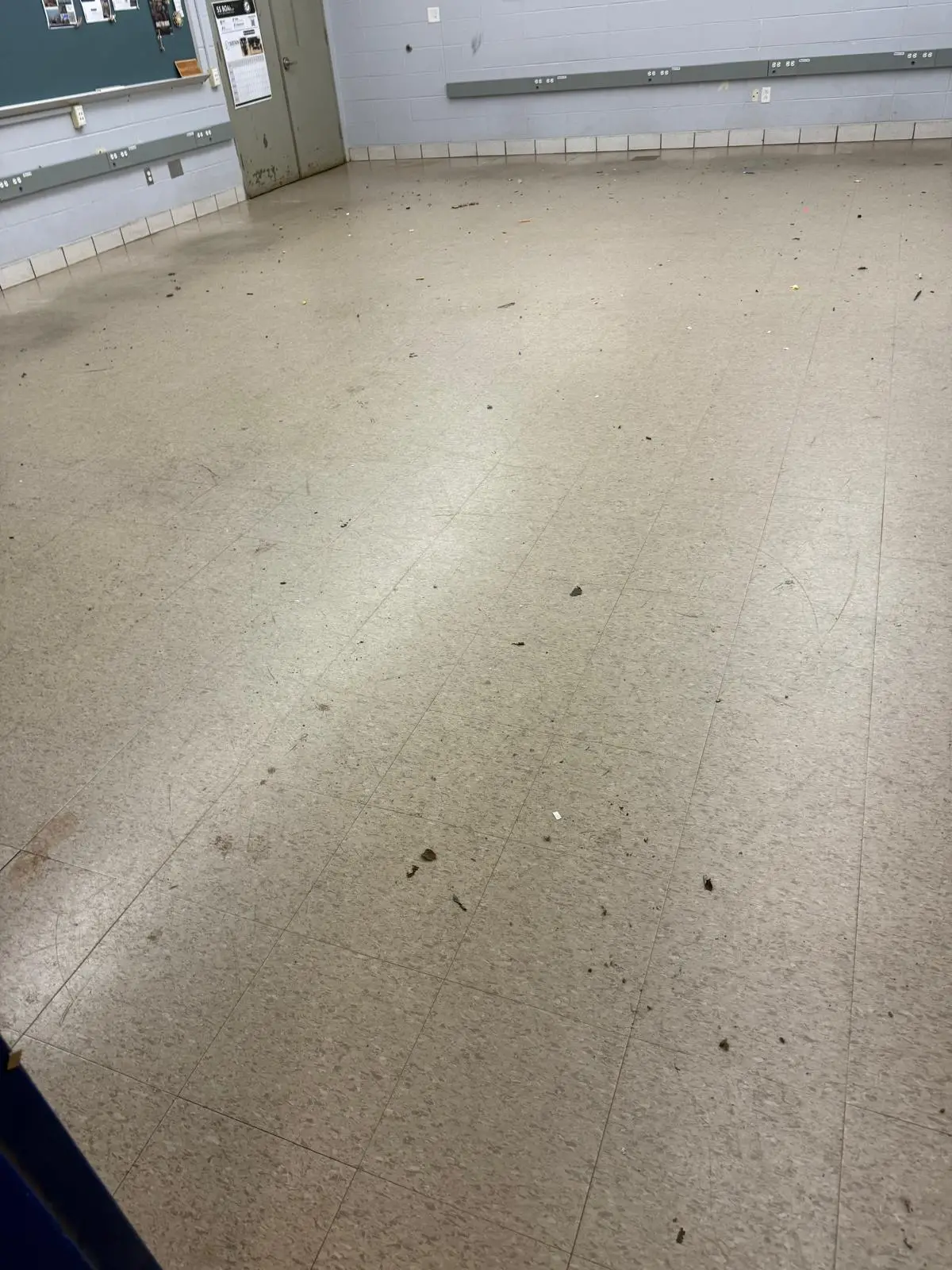
It is worth saying clearly: this floor was maintained all year. Custodial teams handle the daily and weekly work that keeps a school running, and they do it in buildings that take a beating most offices never see. Refinishing is a different layer of care. It is scheduled recovery, not rescue, and the schools that plan it annually are the ones whose floors never look like they need it.
3. Strip It Bare, Then Build It Back
A refinish is not a deep clean. Everything sitting on the tile comes off, down to bare VCT, and then a new finish gets built back in thin, patient coats.
We published a complete walkthrough of that process in our strip and wax floor guide, including how to tell when a floor actually needs it and what a proper job includes. The short version: strip the old finish, neutralize the floor, lay fresh coats, and let them cure hard. Each step exists to protect the one after it, and skipping any of them is how floors end up cloudy, sticky, or peeling by October.
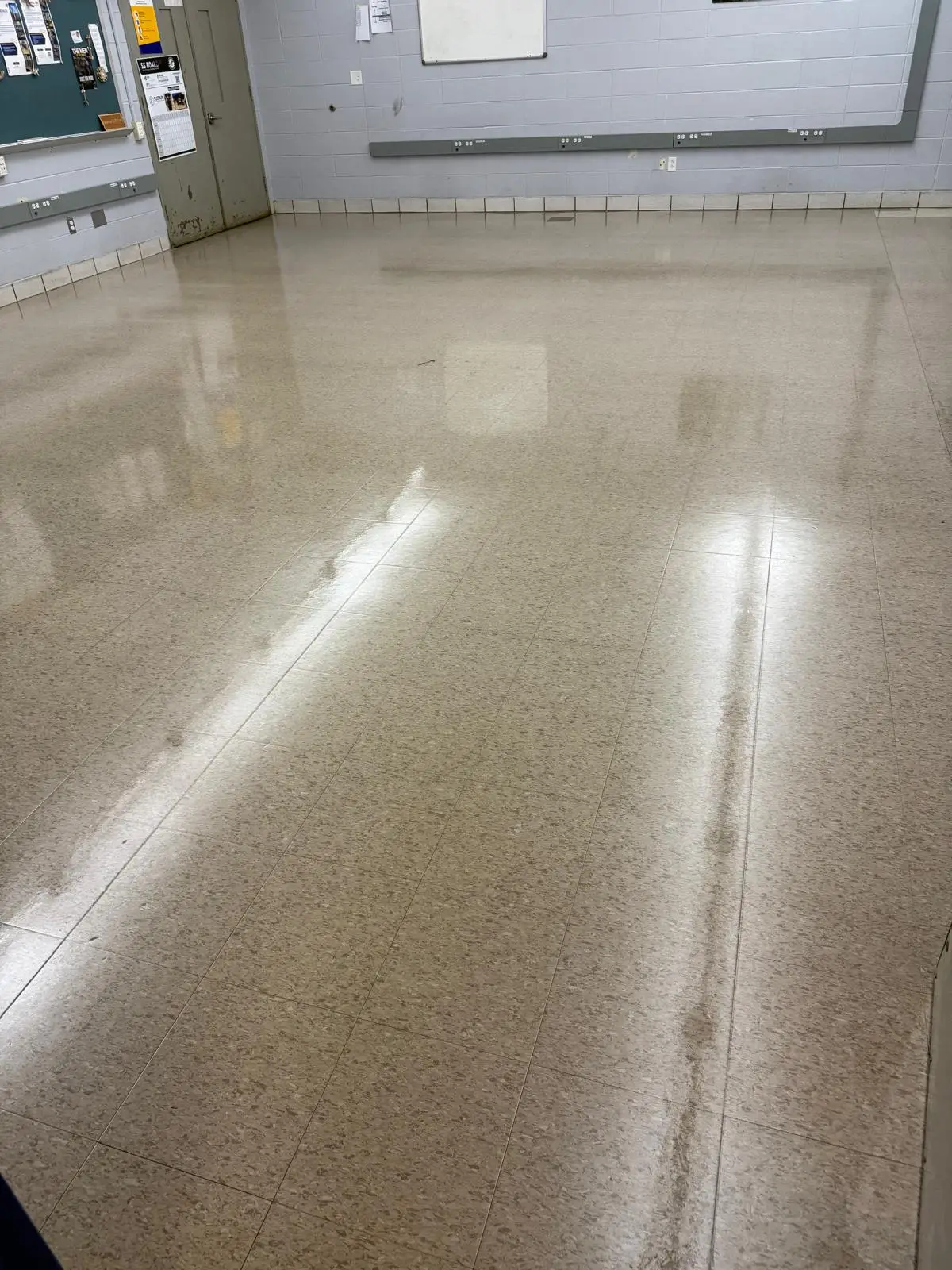
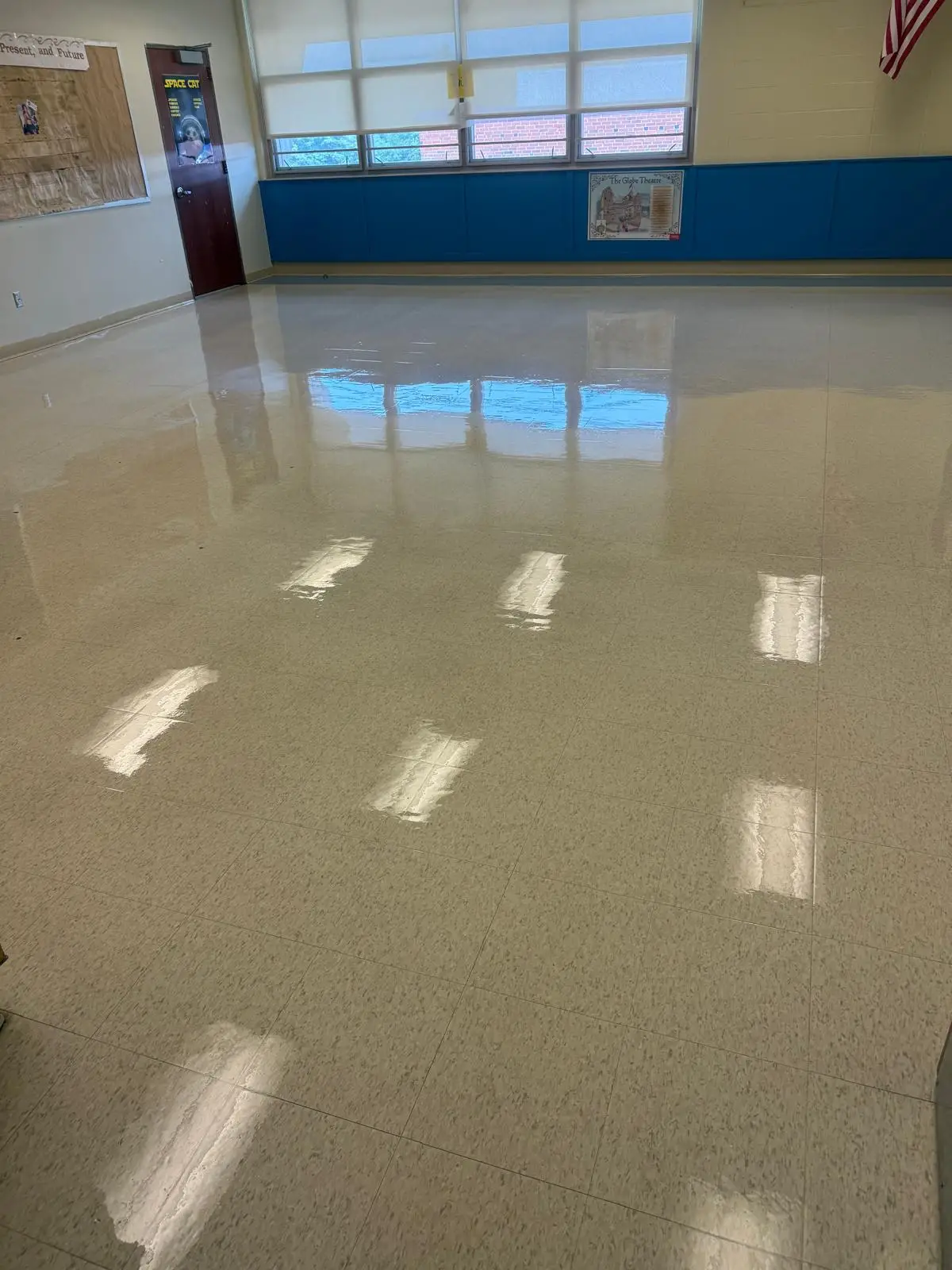
The after photo is the same room and the same tile. Nothing was replaced. That is the part that surprises people who assume a floor this far gone needs new flooring. Most of the time it needs a crew, the right chemicals, and a building with nobody in it.
4. The Hallway Test
Hallways are where floor work gets judged. They are the longest sightlines in the building, they carry every person who enters through the same narrow lanes, and they are the first thing everyone sees on day one.
Corridors also fail first. All of a building’s traffic compresses into them, so the finish in a hallway lives a harder life than the finish in any classroom. When a refinish gets planned, the corridors are never optional. They are the argument for the whole project.
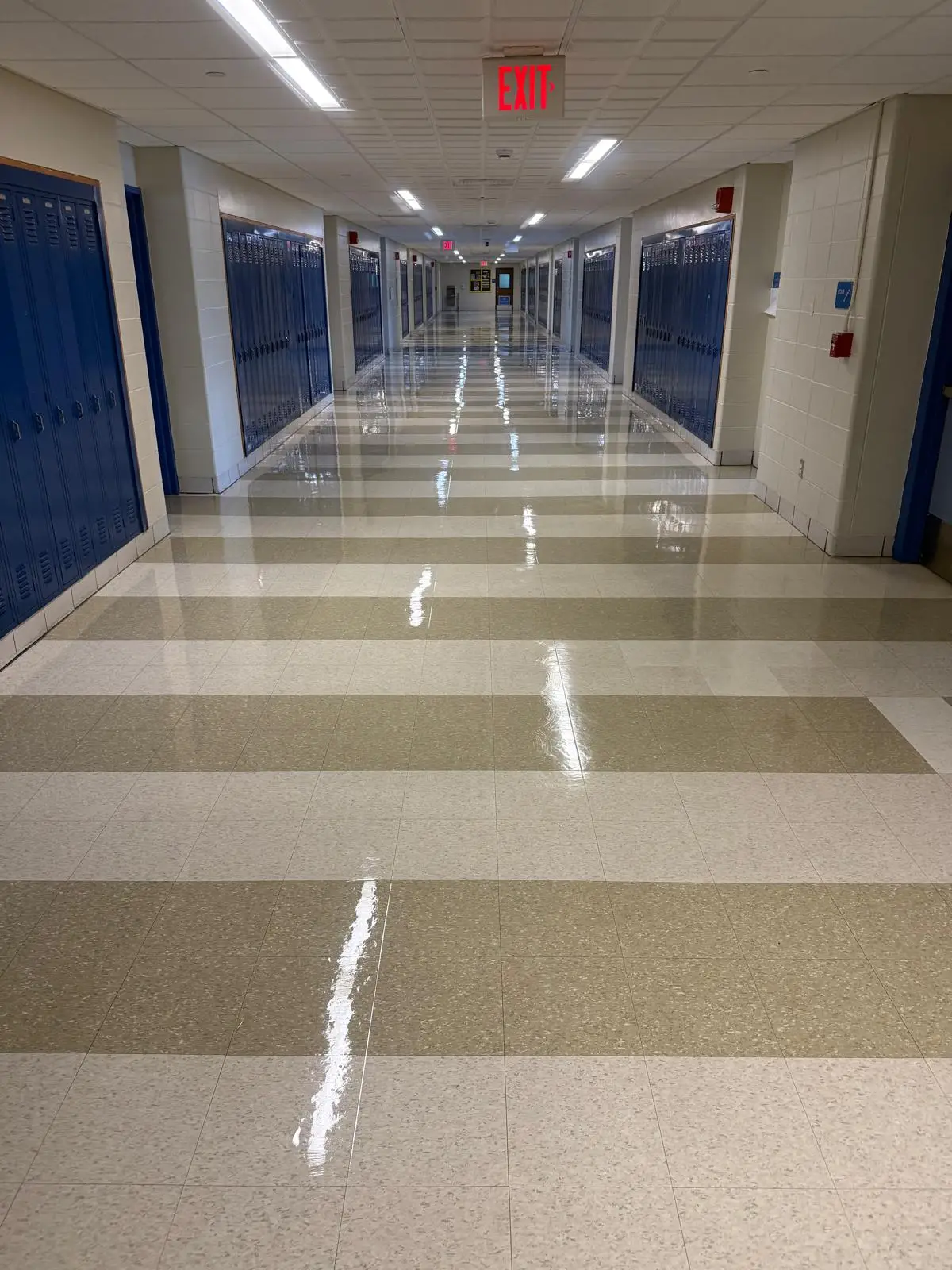
The two-tone striped corridor above is our favorite kind of proof. Those stripes are the original tile pattern, laid decades ago by someone with strong opinions about beige. A worn finish flattens a pattern like that into one dull color. A fresh finish brings the contrast back and runs the ceiling lights down the whole length of the hall. There is a reason floor people photograph hallways the way fishermen photograph fish.
5. Terrazzo Is a Different Animal
Most of this campus is VCT, vinyl composition tile, the workhorse floor of American schools. The cafeteria is terrazzo, and terrazzo plays by different rules.
Terrazzo is stone: marble and granite chips set in a binder, ground flat, and polished. It is one of the most durable floors a building can have, which is why schools built decades ago still have their original terrazzo. It does not get treated like VCT. Where a vinyl tile floor relies on sacrificial coats of finish, terrazzo care is about restoring and polishing the surface itself so the stone carries the shine.
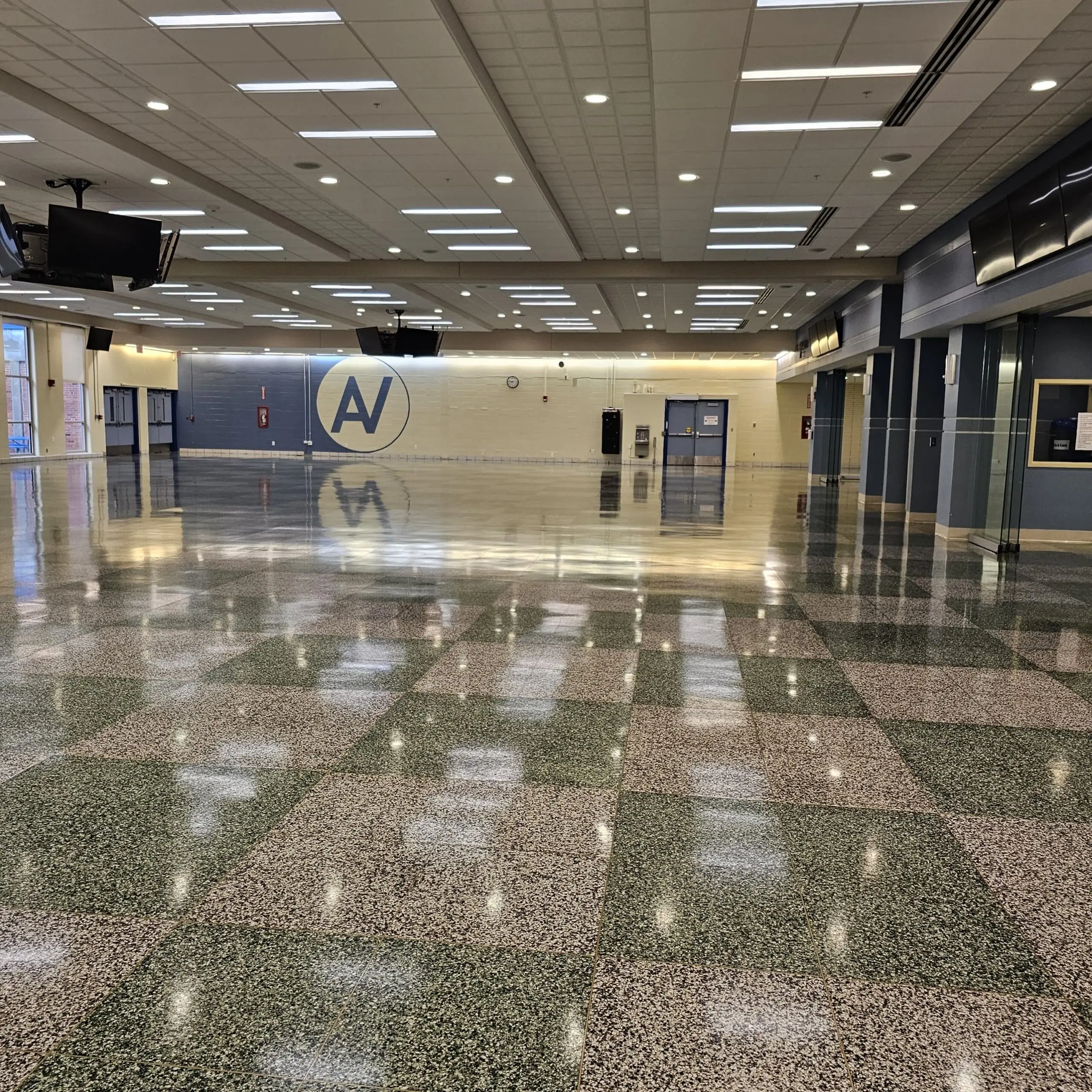
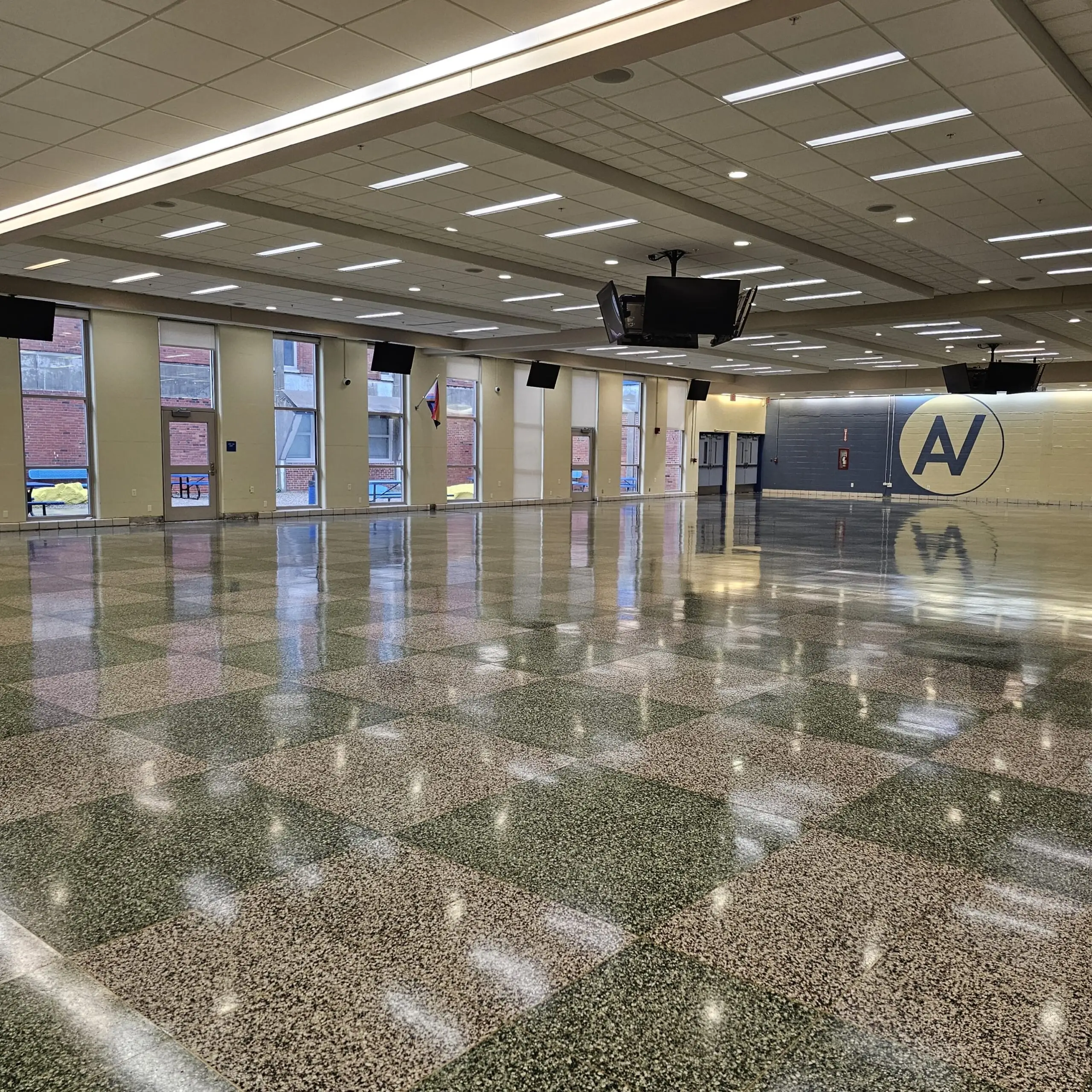
A campus with VCT corridors and a terrazzo cafeteria needs a crew fluent in both systems, because the wrong treatment on either one creates expensive problems. Terrazzo is the cast iron skillet of flooring. Treat it correctly and it will outlive everyone in the building, including the crew that polished it.
6. No, It Is Not Wet
Every floor crew knows this scene. The morning after a refinish, someone reaches the doorway, stops mid-step, and starts the careful tiptoe around the edge of the room. Our owner has watched it happen the day after jobs for years, and it happened here too: people arrive, see the shine, and decide the floor must still be wet.
It is not. It dried hours earlier. A cured floor finish is a hard, dry film, and a hard, dry, extremely smooth film reflects light the same way standing water does. Your eyes see a mirror on a walking surface, and your brain picks the cautious interpretation. We have watched grown adults do the full perimeter shuffle in loafers. We respect the caution. The floor is dry.
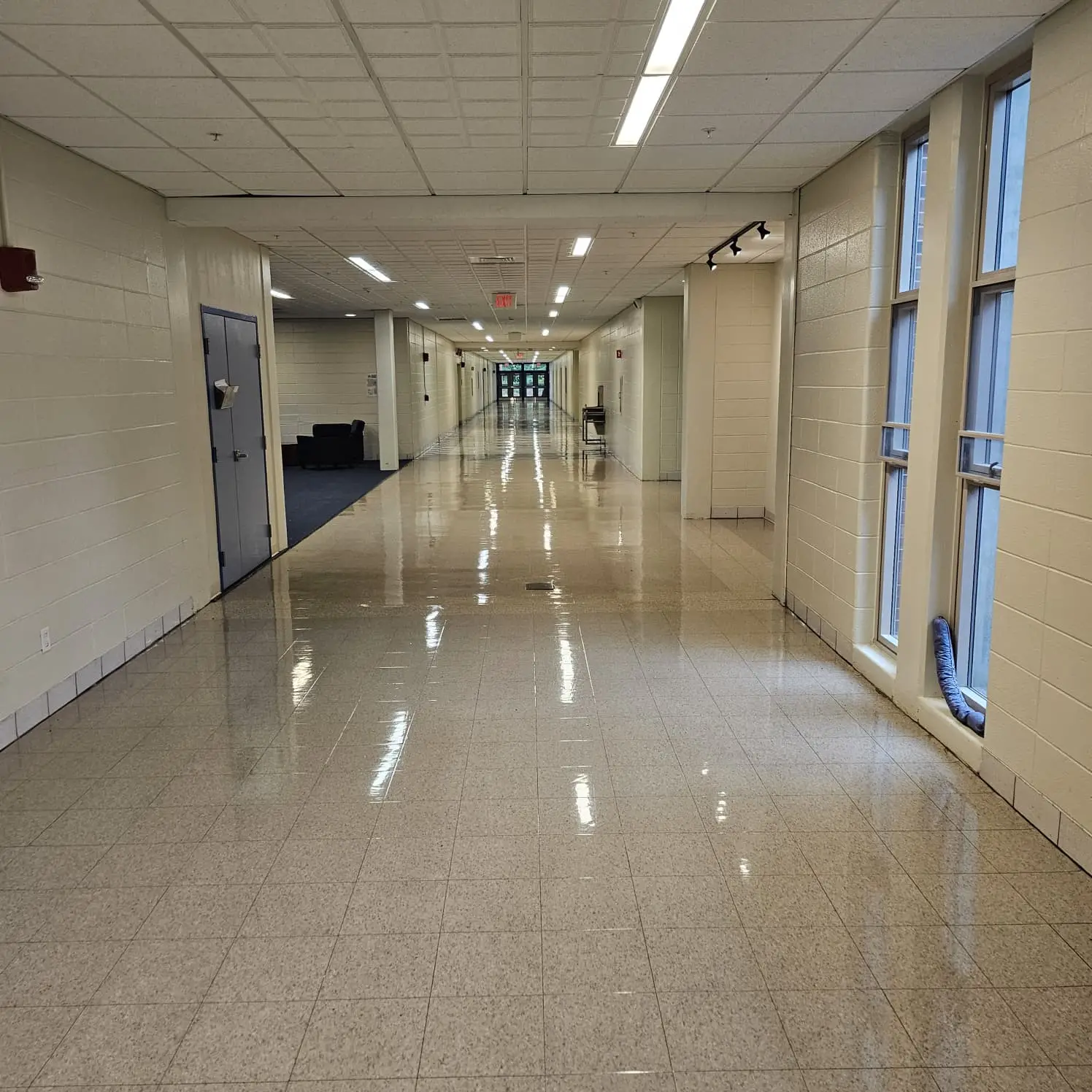
The mirror look is not just cosmetic, either. That reflective layer is the protection. The finish takes the scuffs, the grit, and the wear so the tile underneath does not have to. When the shine finally dulls in the traffic lanes months from now, that is the finish doing its job, not failing at it.
7. Why This All Happens in July
The summer window is not about convenience. It is about cure time and furniture.
Fresh finish needs rooms emptied out and floors left undisturbed while coats harden. In an occupied building, both of those are negotiations. In an empty school, both are free. That is why school floor refinishing stacks up between late June and August across Massachusetts, Connecticut, and Rhode Island, and why facility calendars in education all point at the same few weeks.
Buildings that never empty out do the same work on a different rhythm. Offices, clinics, and warehouses phase it: nights, weekends, one wing at a time, sections roped off while coats cure. The same services apply, just spread across a year instead of compressed into a summer. If your facility does not get a summer break, you get a schedule instead.
Either way, the deadline logic holds. Schools race the first bell in September. Everyone else races their own version of it, whether that is an audit, a client visit, or simply the next Monday morning.
8. One Campus, Four Kinds of Floors
This one job covered classroom VCT, corridor VCT, a science lab, and a terrazzo cafeteria. That mix is normal. A building is not one floor. It is a collection of floors that age at different speeds and want different treatment.
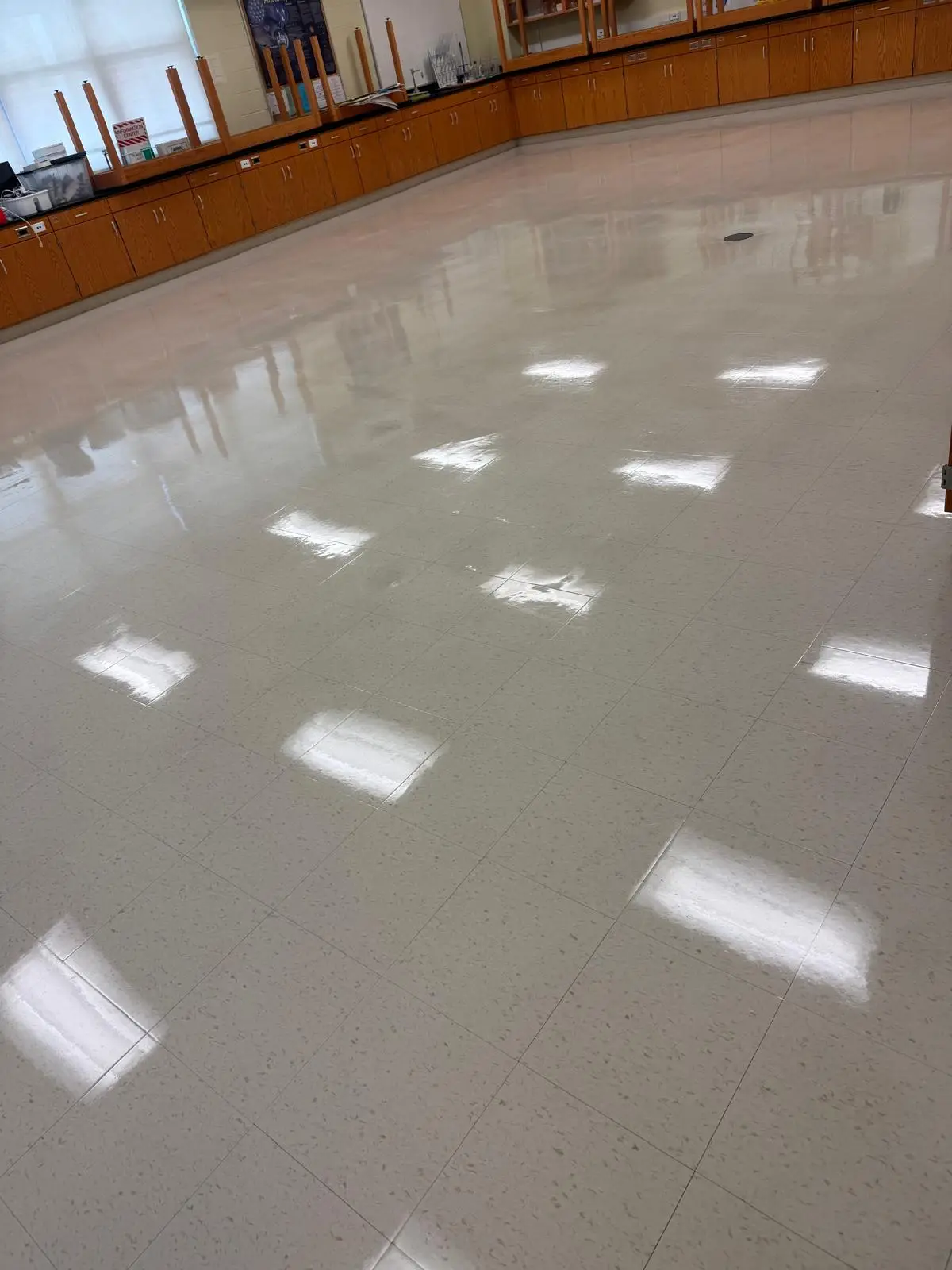
Labs are the fiddly rooms. Fixed benches and casework break the floor into lanes and corners, so the work is less about wide open passes and more about patience. Cafeterias are the opposite problem: huge open spans that show every shortcut. Corridors are pure endurance. Classrooms sit in the middle, room after room of moved furniture and repetition.
Across a year, our crews refinish more than 750,000 square feet of VCT and terrazzo across Massachusetts, Connecticut, and Rhode Island. Schools claim the summer share of that number. Offices, clinics, and industrial floors make up the rest, spread across the other three seasons. At this point our crews have strong opinions about floor finish the way other people have opinions about sports teams.
9. The Owner Was on Site
There is a version of this section where a marketing department writes that quality is our passion. Ours is shorter: the owner was in the building.
Luiz DaCosta owns Modular Concepts, a family-owned company serving commercial facilities since 2008. He visits client sites personally as part of quality control, which is not a slogan. It is a scheduling fact. On this job it meant the person whose name is on the company walking the same freshly finished corridors the client will walk in September, checking the work the way an owner checks it.
The rest of the credibility file is short and verifiable. We are BSCAI verified through the Building Service Contractors Association International, and we work without long-term contracts, which means a client who is unhappy in October can leave in November. Floors like the ones in these photos are what keep that from happening.
10. The Bottom Line
A commercial floor gets one real recovery window a year. Used well, it shows for the next ten months, and everyone who walks in on day one knows it without being told.
If you operate a school, office, clinic, or industrial facility in Massachusetts, Connecticut, or Rhode Island and your floors are overdue for that window, Modular Concepts can help. We are BSCAI verified, we work without long-term contracts, and our owner shows up at client sites because that is how good work gets done.
Reach us at (508) 658-0303 for a no-obligation walkthrough and quote. We will tell you honestly what your floors need, what they do not, and what it should cost.
Frequently Asked Questions
How often should school floors be stripped and waxed?
Traffic decides, not the calendar. Corridors and cafeterias carry the most wear and typically need the most frequent full refinishing, while classrooms and offices can often go longer with maintenance coats in between. The reliable answer comes from a walkthrough: the state of the finish in the traffic lanes tells you which floors need a full strip and which just need attention.
Can floors be refinished while a building is occupied?
Yes. Occupied buildings phase the work: nights, weekends, one section at a time, with areas roped off while coats cure. Schools simply get to skip the phasing by using summer break, which is why so much education floor work lands in July and August. Offices, clinics, and warehouses run the same process on a year-round schedule.
Is a high-gloss floor finish slippery?
Shine and slip resistance are different properties. The mirror look comes from a smooth, hard, fully cured film, not from anything wet or oily sitting on the surface. A floor that is actually slick has something on it or something wrong with it, and that is worth a conversation with whoever maintains it.
What is the difference between VCT and terrazzo?
VCT is vinyl composition tile, an economical resilient floor protected by sacrificial coats of finish that get stripped and reapplied over its life. Terrazzo is stone, marble or granite chips set in a binder and polished, and it is cared for by restoring the surface itself. Both are common in schools, often in the same building.
Does Modular Concepts refinish floors outside of schools?
Yes. The same crews handle VCT and terrazzo in offices, medical facilities, non-profits, and industrial buildings across Massachusetts, Connecticut, and Rhode Island. School campuses dominate the summer calendar, and everything else fills the rest of the year on phased schedules built around each building’s hours.
Sources
Massachusetts Department of Elementary and Secondary Education, 603 CMR 27.00: Student Learning Time (180 school day requirement): doe.mass.edu/lawsregs/603cmr27.html.
Building Service Contractors Association International (BSCAI): bscai.org.
Annual refinishing volume (750,000+ sq ft of VCT and terrazzo) supplied by Modular Concepts ownership, August 2026.
Photos: taken on site by the Modular Concepts crew, summer 2026, at a public school campus in MetroWest Massachusetts. Client name withheld.